




Surely only Storrie’s most ardently committed new fans will venture out to see this, though: It’s hardly an embarrassing blot on his résumé, but it’ll be forgotten long before the second-season premiere of the queer hockey phenomenon. For writer-director Michel K. Parandi, making his feature-length debut, “April X” will be a more critical calling card — and duly shows off some resourceful technical ability on a cramped budget. But his script, co-written with regular collaborator Jack Coulter, is less impressive, welding together story scraps from other, better films to rather turbid, uninvolving effect. It occupies a similar genre space to the recent release “Hot Spot,” Agnieszka Smoczynska’s comparably scrappy, patched-together vision of compromised human identity in the middle-distance future; that film was a misfire, but a measure of its imaginative eccentricity would still be welcome here.
In this grimy waking nightmare, twins Baxter (Storrie) and April (German actor Lilly Krug) barely eke out a living doing a variety of sketchy jobs, some more criminal than others. He traffics organs on the black market, while she has a special gift for dreaming: At a time, apparently, when nobody has slumber visions anymore, hers are enviably lucid and vivid, to a marketable degree. April’s selling of her dreams to others wishing to experience her sensations isn’t a fresh idea — paging “Strange Days” — but it’s one of the more fertile ones here, and goes frustratingly unexploited as the film continues to probe a single glum reality.
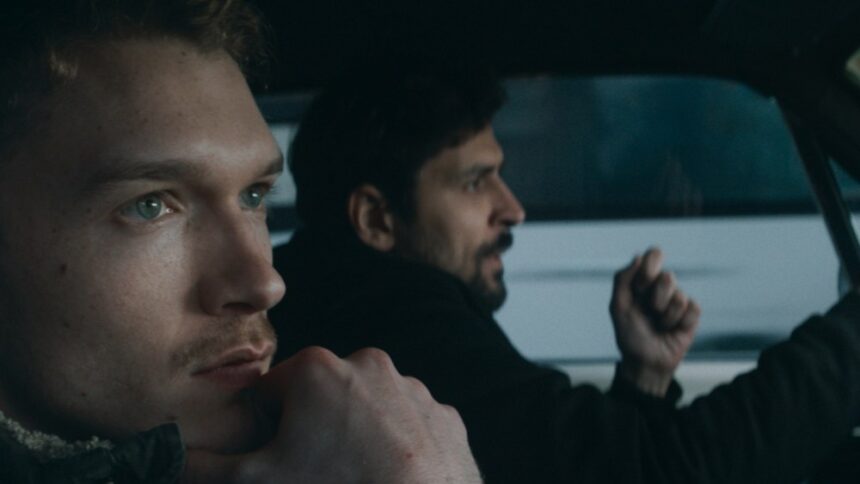
We’re more concerned with Baxter, whose underworld dealings eventually see him run afoul of local gangster Klein (Serban Pavlu), and the twins’ combined savings aren’t enough to allay the severe consequences. Soon April disappears, and Baxter’s desperate search for her begins. It’s ongoing when the story suddenly lurches five years into the future: The world looks much the same, but his hair is briefly longer, while April has seemingly been cloned into a number of identikit sex workers. Whether her brother can locate her soul in any one of them, or somehow implant it via her recorded memories, is the film’s big existential question — but the characters themselves aren’t drawn with enough warmth or personality for us to really care either way.
Storrie soldiers through it all with a clenched jaw and a steely gaze, but the film’s world never comes fully to life. Nathan Haugaard’s sheeny widescreen lensing and Oana Novicov’s distressed production design ensure it looks pretty good, but “April X” is missing the granular particulars and textures that might make us believe it: The narrative, likewise, is just cohesive enough, but the details of Baxter’s life and livelihood are so muddy that he doesn’t have our full attention. Parandi’s film winds up outlining a dystopia more dull than devastating — though perhaps that’s the future we should really be fearing.