



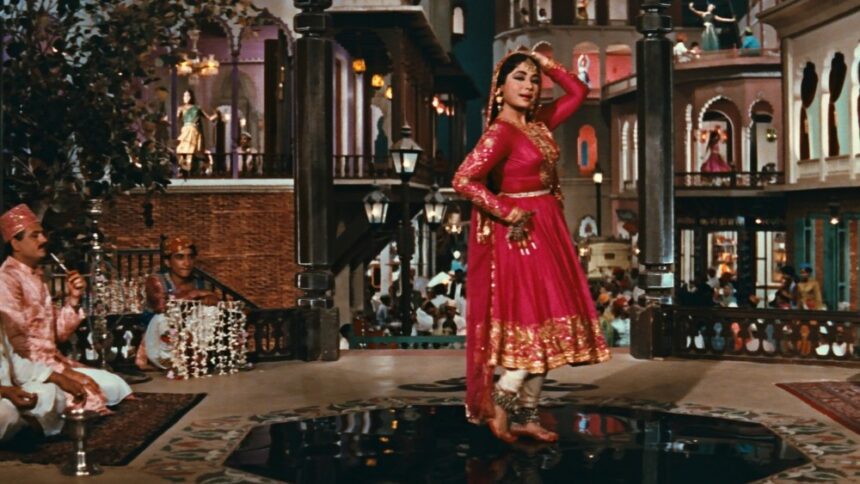
On the night of Feb. 3, 1972, the prints of “Pakeezah” arrived at Bombay’s Maratha Mandir cinema in a palanquin pulled by four horses. Military bands played outside, police held back the thousands crowding the gates, and inside, the film’s star, Meena Kumari, sat beside her husband, director Kamal Amrohi, and gripped his wrist so hard through the screening that her nails drew blood.
Amrohi’s son Tajdar was in the theater that night. His father never pulled his arm away.
“He just gave a smile, and she also smiled in an embarrassment, you can say,” Tajdar Amrohi says. “And it seems that even after 54 years, I feel as if that incident took place yesterday.”
Kumari died on March 31, 1972, weeks after the film opened. Now, Film Heritage Foundation’s (FHF) 4K restoration of “Pakeezah,” carried out with the Amrohi family, is back in front of audiences. Thierry Frémaux presents its world premiere at Festival Lumière in Lyon on Wednesday. It then plays a gala at the BFI London Film Festival’s BFI Imax on Oct. 18 that Shivendra Singh Dungarpur, the foundation’s director, will introduce with Tajdar Amrohi, his sister Rukhsar Amrohi and Kamal Amrohi’s grandson Bilal Amrohi. Dungarpur says he heard the Imax screening sold out “in no time.”
Through all of it, Amrohi refused to let the film go.
“His relations, his health, his wealth – he put everything into ‘Pakeezah,’” his daughter Rukhsar Amrohi says.
She remembers that every household request, from new decor to things for himself, got the same answer: after “Pakeezah.” His kurtas (tunics), which usually arrived from Lucknow a dozen at a time every six months, wore thin during the shoot. When she pressed him to reorder, he told her that people came to see him, not his clothes.
“I’ll order all of this after ‘Pakeezah’ – not 12, I’ll get 24 – but let my ‘Pakeezah’ get into theaters,” she recalls him saying.
“Isn’t that a sacrifice?” she says.
“Just as Shah Jahan immortalized Mumtaz Mahal by building the Taj Mahal, Kamal sahab [sir] immortalized Chhoti Ammi, Meena ji, across the whole world by making ‘Pakeezah,’” he says.
“It’s one of my most beautiful memories of restoration, and the most important film in my life,” he says. “She was the driving force on seeing this restoration.”
“So much money is spent on the production, so much money is spent, but there’s very little money spent on preserving these elements,” he says. “And that’s been quite a tragic story of India’s cinematic history.”
Tajdar Amrohi still regrets that “Pakeezah” won no awards. When he once complained about it to his father, the director just smiled.
“You haven’t noticed one thing,” he told his son. “All these people who are coming to watch the picture – that is my award.”