



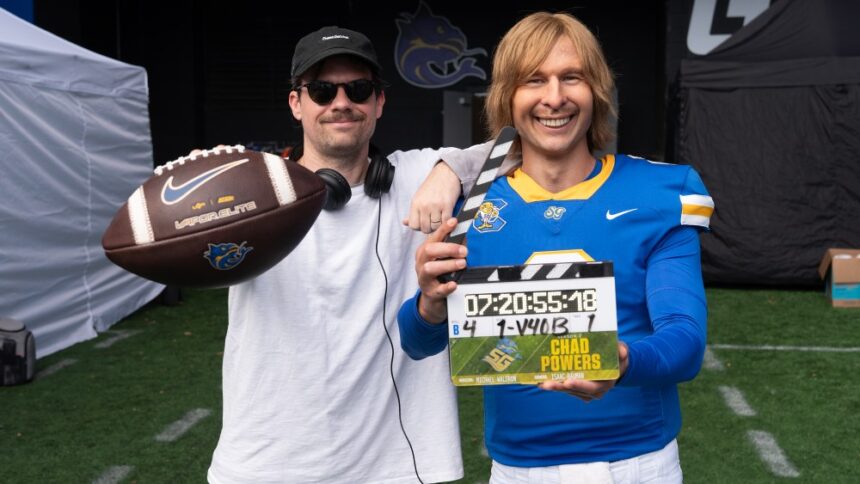
“It’s a deep, and deeply stupid, show,” co-creator Michael Waldron says, laughing knowingly from his corner of the Zoom window. “And I’m very proud of it.”
In the first 28 days of Season 2’s release, the show has demonstrated what Nielsen calls “strong audience stickiness,” averaging 2.75 million viewers per episode in the U.S. (Those numbers are relatively comparable to Season 1, which averaged 2.96 million viewers per episode.)
“Making this show is the great joy of my career,” Waldron says. “I can’t believe how specific it is, and yet, the audience keeps finding it. It just makes me happy that people are digging it.”
The industry has responded, too: Rotten Tomatoes’ critics score surged from 60% in Season 1 to 93% for Season 2. (The audience popcorn meter rates Season 2 at 93%, compared to 85% for Season 1). Many of those reviews credited the series’ shift to a darker tone, which Waldron, who directed four of the season’s six episodes, crafted to evoke “Point Break” and films from Tony Scott, Jonathan Demme and Sam Raimi.
“We shoot six-day episodes, but our level of ambition is to look like we’re a big movie,” Waldron says, explaining that he and cinematographer Isaac Bauman were determined to create a “cinematic experience.”
Michael Waldron directs on the set of “Chad Powers.”
Disney
There’s also a major development in the “RickyRuss” romance department. (“There’s a nice little fandom out there for them online that I keep my eye on, and hopefully all those folks, as they would say, feel like they’re getting ‘fed’ this season,” Waldron cracks.)
With Season 2 now streaming, Waldron is turning his attention to a potential third season. He and Powell designed the story to evolve in three parts, following the fictional South Georgia Catfish over the course of one football season.
So, if, and seemingly when, Hulu renews the show for Season 3, audiences will watch the Catfish compete to win the Natty (the national championship game) — which could signal a rematch with Waldron’s Georgia Bulldogs or the Texas Longhorns (Powell’s college team).
“Nothing’s guaranteed,” he continues. “But in the same way that, this season, we tried to subvert the audience’s expectations of telling a sports story — which has these predictable conventions: the rise and fall and rise again — we’ll try and keep doing that.”
Ricky’s last line of Season 1 is “I hate you.” How did you and the writers craft the arc to Russ saying “I love you” at the end of Season 2?
I’d like to say that was some grand plan to go from “I hate you” to “I love you,” but as always happens, it’s something that we found more organically. I remember working on that last scene and realizing we’d gotten to the point where that was earned. It felt like an honest moment.
There’s so much debate in the writers’ room over, “Are we ruining the show if they kiss?” When you have a “will they, won’t they,” when they kiss, it’s like, “What happens to the tension of the show?” So, we talked a lot about the kiss, but Russ expressing that he loves her was kind of a surprise to me. It was one of those amazing things that came over the course of working on the finale script, and even as we were shooting the show. It felt like we’d watched the characters earn that on this journey, so it became a really nice mirror to the very tragic end of season one.
Going back a bit: season one marked your directing debut, and now you’re directing two-thirds of the episodes. Was there a scene that was as difficult as shooting at Georgia at halftime?
This season, there’s a lot of visual references to unmasking and peeling back the layers of the face Chad put on in Season 1. How did you look at this second part of his arc?
That’s why, in the final football sequence, he runs the play like Russ, because of Ricky, Danny, Coach Hudson and all these amazing people that have come into his life. Not because of winning, not because of the football, but he is able to forgive himself a little bit. At least for that one play, he’s finally Russ again because he’s kind of OK with himself.
A scene from the “Chad Powers” Season 2 finale, “12th Quarter,” where Chad and the Catfish must beat Texas to make the College Football Playoff.
Disney
I imagine that was also the only way that Glen would allow Texas to lose on screen.
I’m so glad you mentioned that because, if something happens off-screen, it didn’t happen. So, the Catfish fans can say “Dawgs Pounded” all they want …
There was a lot of debate in the writers’ room. Me saying, “Well, they have to lose, but how could they win?” At some point, somebody in the writers room said, “Do you want what’s best for the show? Or do you want what’s best for the fictional University of Georgia football team?” And I was like, “Fair enough.” So, apologies to Kirby [Smart] and the Dawgs for them taking the regular season L here.
They lose to a team that lost to Vandy at home. Who does that?
I know! And Arkansas! [Laughs.] It’s tough, but I’d like to think that loss to the Catfish probably gave Kirby motivation. Who knows? We don’t know what’s going to happen in Season 3. Maybe they meet again.
Speaking of things that don’t happen on camera, Gerry does not get killed on camera, so what are the chances that he lives? He has seen all the mask-making technology. Does Trisha just keep him around in case she needs a foil if Chad gets out of line?
I think Gerry’s story is far from over. Trisha has temporarily taken him off the board, but who knows where he goes from here? But certainly, Season 3, if we get to make it, would have to pick up right after this episode.
Tell me about crafting Gerry’s arc and how unhinged you let him get.
That’s true: Chad comes in, lies to everyone and takes Gerry’s job. Gerry gets assaulted by the costumed mascot. Then they plant a gun on him. But let’s talk about the sequence set to “Don’t Laugh at Me,” which I did not know was a real song.
[For that sequence,] I was like, “Colton, you’re going to be in a jockstrap,” and Colton was like, “Put me in, Coach.” Colton was cutting weight, getting jacked and talking to Glen about how to get ripped on camera on the day. And he looks amazing. There’s plenty of amazing footage on the cutting room floor.
What is the origin of those Chad masks?
A scene from “Chad Powers.”
Disney
Speaking of “Point Break,” you wore a Val Kilmer hat to the Season 2 premiere party. Why was that one of your references this season?
Then, in terms of the way we moved the camera, I wanted to feel like it was on the run. Our characters are in a pressurized situation, so how can we make the audience feel that, and how can it feel cinematic? It’s Glen Powell on TV. You’re stealing something. Episode five was the genre episode, where we got really into the Jonathan Demme close-ups, where we’re looking down the barrel at everything.
You set the meeting where Gerry blackmails Chad in a movie theater, with “Edward Scissorhands” playing. What was the thought process behind that?
“Edward Scissorhands” is certainly apropos: a story of a simple man falling for a beautiful woman and causing a lot of pain to the community around them. We’re lucky to have those clips and that bit of Danny Elfman’s score, and the way that interacts with Natalie Holt’s score.
I love the millennial nostalgia references too, like a “Remember the Titans” reference in episode 201.
I keep seeing people say this show’s very millennial coded, which secretly makes me feel old.
Since we’re talking about directing, your next directing break might be making “Nova” for Marvel. What would it mean for that long-held goal to come true?
I don’t even know what I can say as an answer to this question without my computer just catching on fire. But I love the character of Nova. I love Rich Ryder, and I’ve gotten to work at Marvel with a bunch of great filmmakers. I worked so closely with Sam Raimi and learned so much from him.
Have you thought about a way to get Glen cast in the film?
These are the questions to be hypothetically asking someone who was hypothetically directing the movie. But that person, if they wanted to hold on to that job, should not answer those questions.
Let’s circle back to Val Kilmer. We’ve talked about “Point Break” and “Tombstone” as references — do you see a parallel between these two actors?
In this show, you take it for granted, because there’s a real magic trick happening where he’s under these prosthetics — big fake nose, fake teeth, ridiculous wig. He’s having this emotional, cathartic argument with Toby Huss — whose prosthetic makes him look like Jon Voight in “Heat.” It’s this great piece of drama and Glen’s just anchoring it, and you forget how stupid he looks. I just can’t say enough about him as an actor, as a collaborator and just as my pal. I’m so proud of the work he did this season. He’s an absolute genius.