



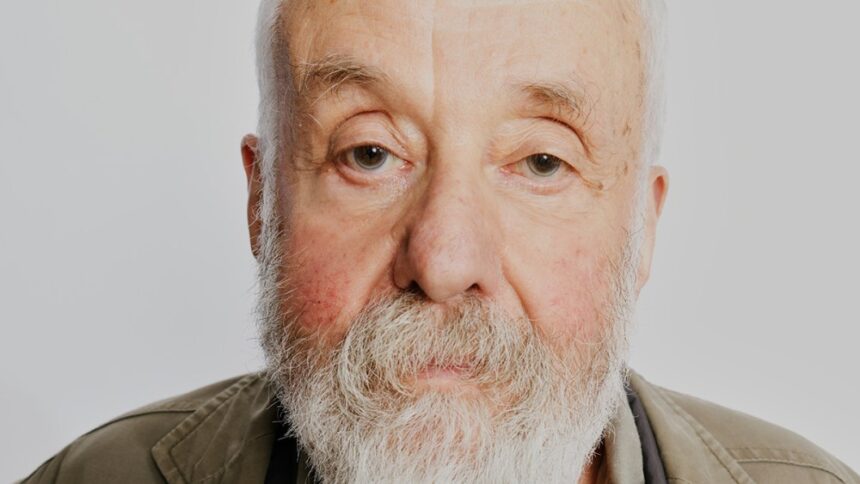
No one tells Mike Leigh what his movie is about. Not financiers, not distributors, not even Netflix, which he says could fund him “without batting an eyelid” but never has. At 83, Leigh is exactly the man he has always been: an artist with integrity. He’s telling this story to prove it.
Kate O’Flynn, Marion Bailey and Alice Bailey Johnson in “Tender Loving Care”
Now someone has said yes one more time, and it may be the last. Bleecker Street is funding “Tender Loving Care,” Leigh’s sweet, funny study of two social workers, their family and the people they look after. It’s the lowest-budgeted feature of Leigh’s career, and, he says with some reluctance, almost certainly his final film.
“Tender Loving Care” plays like a farewell — to cinema, and to movie lovers — though Leigh insists it may not be. The film, wry and melancholy, follows Amy (Kate O’Flynn), freshly gutted by a breakup, as she moves in with her childhood best friend, Rosie (Alice Bailey Johnson), a fellow social worker estranged from her family. Around them orbit Amy’s long-married parents, Birdie (Marion Bailey) and Geoff (Paul Jesson).
Leigh and I spoke about the film, the finality and the half-century behind both.
Where did the title come from?
I always title the films absolutely last, as late as possible. It’s about the two social workers, yes, but also the old couple, the girls, people caring for each other. “Tender Loving Care” felt so obvious, I thought, “We can’t call it that.” Everybody said, “No, call it that.” So we did.
So much of that is the friendship between Amy (O’Flynn) and her best friend Rosie (Bailey Johnson). Can you talk about writing Rosie as an extension of a family she’s not related to by blood? Can you talk about writing Rosie as an extension of a family she’s not related to by blood?
My sons are in their mid-40s, and there are people they’ve known since childhood who are part of our world. It’s that whole web of long relationships that matter.
Mike Leigh on the set of “Happy-Go-Lucky” in 2008.
Miramax/Courtesy Everett Collection
You build films around people you know intimately. Marion Bailey has been your partner for many years.
Marion and I being partners, and Alice being her daughter, are good, but it’s neither here nor there.
Birdie has a line — “In the old house, before we moved” — that hands the character an entire history in half a sentence. How much do you think about a character’s past?
A lot. Throughout the film you learn how Birdie and Geoff first met, about Amy as a wayward 14-year-old, about the woman who comes around having lost her husband. It’s always there in my films, but this one does it a great deal — because the audience needs to understand these people in more than three dimensions.
Where does a Mike Leigh film start? When you finish one, do you know what the next will be?
Those are two questions. I don’t do the conventional thing: think what the movie is, sit down, write it. I discover the film on the journey of making it. I start with notions, then work as people paint pictures or write novels: You embark, you get clues back and that dictates where you go next. And it’s not just me — it’s an interaction with the actors and things that happen through improvisation.
You walk into financiers’ offices and ask for the money with no plot or script — just “Trust me.” Could a first-time Mike Leigh get that meeting today, let alone the cash?
The terrible news is probably not. I was extremely lucky in the early days. There have been plenty of times we’ve been told to fuck off by people who could have paid. The problem now isn’t that the money isn’t there; it’s that the people with it want to control things, to interfere. Somebody who won’t tell you what it’s about or who’s in it, and doesn’t want to be interfered with, is anathema to them.
It would be tough now.
Has the way films get financed changed the kind of films that get made?
You’ve said this is probably your last film. Is that really the case?
Was there a moment on set, or when you were writing, when you decided this could be your final film?
Does that truth bother you?
I fluctuate. One minute, “Great. I don’t have to worry about that again.” The next, “Making films is a joyous thing, a gas — I love it.” So not doing it again is frustrating. But, like life, you move on.
Talk about this stunning cast quartet you have assembled — Kate O’Flynn, Marion Bailey, Alice Bailey Johnson and Paul Jesson.
Kate [O’Flynn] is completely devoid of bullshit. She and I come from within a couple of miles of each other in Manchester. She’s down to earth, practical, with a massive sense of humor and no ego — though that’s true of everyone I work with. She’s a consummate character actor, and what she does in “Widow’s Bay” is phenomenal. A fantastic character actor, a great human being and very funny. She’s a hoot.
Marion [Bailey] has a great sense of character, a great sense of humor, easy to work with, a consummate character actor who can become somebody else entirely. But what she taps into here is her empathy and compassion. I agree she’s underrated. And then Paul Jesson — incredibly versatile, great gravitas, a joy — he’ll do anything, no fuss. The guy’s 80 and he just does it. No bullshit; he delivers the goods, with a great sense of humor. He and Marion have worked together with me a few times. Old team.
More than 50 years, from “Bleak Moments” in ’71 to now — is there a through line you can see?
42.
So can you look back at 42 years and see what led to this moment?
Both yes and no — I get impostor syndrome, that feeling I’m not supposed to be here, that others worked harder. Does that happen to you?
I don’t like a world where I don’t think a new Mike Leigh movie is ever coming out again. Most filmmakers and artists ever know which one will be their last. How are you feeling about that?
I’m not really thinking about it as the last movie. Thinking of it that way isn’t the same as knowing I’m unlikely to make shoot. These are two different things.
Let’s talk about your Oscars history. Seven nominations — five for writing, two for directing — and no win yet. Is there one loss that stings?
You’d love to win; you’re not surprised when you don’t. I won’t score votes for saying it, but it’s one of the worst-organized events, and I am shambles. What I care about is people seeing the film.
Is there a film of yours you can’t watch anymore — or one you’d happily sit through tonight?
I’m fond of “Meantime.” Honestly, I have a privilege many filmmakers don’t: I quite like my films.
People ask if I ever watch them — yes, especially with an audience at a gig. A lot of filmmakers can’t watch their own films, because it’s not the film they wanted; it was interfered with by the backers. That’s never happened to me. Everything on screen is what I wanted there. I’m not Gloria Swanson in “Sunset Boulevard,” watching my movies every night, but I can watch them. Last Christmas Day, Marion and I put on “Topsy-Turvy” and thoroughly enjoyed it.
What would you tell a young filmmaker starting out?
Never compromise. Never say, “This isn’t really what I believe in, but if I do it, then I’ll get to do what I want.” That’s bullshit. Stick to your guns.
Any regrets, as a filmmaker, or in life?
And how’s Mike Leigh feeling today — at peace, grateful, restless?
It’s a chaotic world, and you’re calling from a chaotic country — the sooner they get rid of you-know-who, the better. They probably won’t let me in now that I’ve said that.
Do you think you have room in your home for me, my wife and two kids? We make good houseguests.
The problem is, you’re not invited, I’m afraid. You don’t stand a chance.