



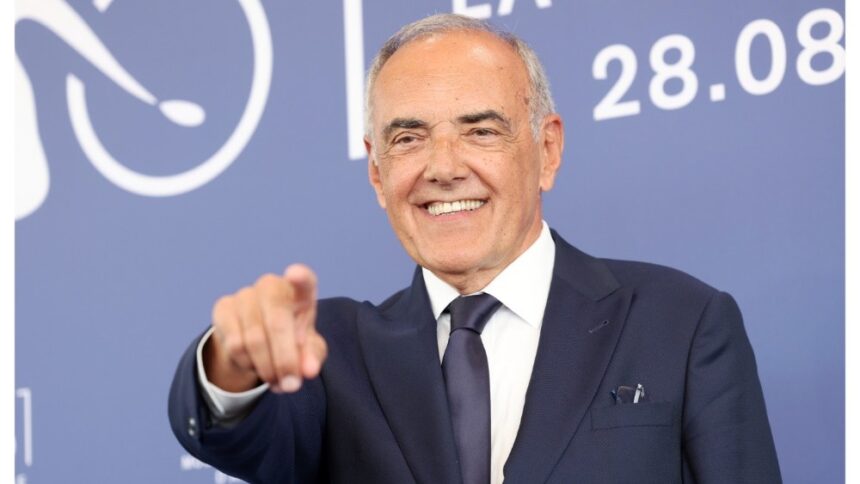
Venice Film Festival artistic director Alberto Barbera spoke candidly Tuesday about the political pressures surrounding this year’s edition, while making clear that the fest has no intention of shying away from controversy.
“There are several films that can start controversies or, at the very least, provoke very strong political reactions,” Barbera said. “They ask whether the festival — and especially the Biennale — is going to take very clear and explicit political positions. What we always say is that neither the Biennale nor the festival will make political declarations in order to take sides.”
His comments came a day after Venice reinstated its jury press conference amid some backlash and as artists and activists, including Venice4Palestine, have called on the Biennale to take a stronger position on the war in Gaza.
“We are a space for freedom of expression. Our role is to safeguard freedom of expression for everyone, for the artists, and to safeguard the confrontation between artists and the public, the critics and people in general,“ said Barbera. “We will never take an explicit political position. It doesn’t make any sense.”
Barbera also firmly denied that the absence of Israeli films from this year’s lineup reflected a boycott, saying Venice received only one Israeli submission and chose not to invite it.
“We know the situation in Hollywood. We know the situation of the studios. They are in difficulty,” he said, pointing to mergers and shifting production and distribution strategies.
Still, Barbera predicted the studios would return, calling Venice “a very good promotional opportunity.”
Venice opens Wednesday with “Ink,“ Danny Boyle’s drama about the birth of Rupert Murdoch’s tabloid empire, starring Jack O’Connell, Guy Pearce and Claire Foy.
Why does everyone seem to want Venice to take a political position this year?
But they are actually asking you to do that?
Yes, they are asking us. For example, you know that the pro-Palestinian groups sent a document — the letter — asking for an official pro-Palestinian declaration and all of that. But after all, we are a space for freedom of expression. We invite films. We understand that there will be discussions, debates and everything that comes with that. Our role is to safeguard freedom of expression for everyone, for the artists, and to safeguard the confrontation between artists and the public, the critics and people in general. We will never take an explicit political position. It doesn’t make any sense.
But at the same time, I think it is clear what our position is, because through the program, through the programming of the festival and through the films that we invite, it is clear what we are doing and what kind of space we want the festival to be.
But you don’t have any Israeli films this year, do you?
No.
Why is that?
First of all, because we received only one Israeli film. One single Israeli submission. We didn’t like it enough, so we decided not to invite it. And for the first time, we didn’t receive any other proposals for Israeli films. I don’t know why.
So there is no boycott?
At one point, apparently you almost took the Vincent Gallo film with James Franco. What happened there?
Yes and Vincent told us in the end that he preferred that we not do anything. He only wanted to come if he was in competition.
Really?
Was it a film that would have created controversy because of the film itself, or because of Vincent Gallo and James Franco?
No, because of the film. Because of the subject.
Because it is about a serial killer? Because it makes the serial killer sympathetic?
No, but you know, with Vincent Gallo there is always an approach that is, let’s say, troubling. There is always something unsettling in the way he approaches a subject.
But James Franco as well — wasn’t that a concern?
It seems that at Venice you can get away with things that at Cannes would immediately spark a huge backlash from journalists, the industry and everyone else. Why do you think Venice can do that?
Why Venice? I think because of the prestige of the Biennale and the credibility that the Biennale has gained over the years through its international positioning and through decisions that people have appreciated. It has built this credibility through its defense of artistic freedom and everything that goes with that, without ever taking a political side.
It depends how good his next film will be! We’ll see. Maybe.
There are a lot of French and Italian films and filmmakers coming this year, but there are fewer Americans. Do you think the Americans will come back?
Are the studios also afraid of going to festivals like Venice because the critical reaction can be so tough?
But it’s expensive to come to Venice.
It is not expensive. It depends, obviously, but if you have a film that costs $200 million and the studio is spending $5 million or much more on promoting the film, then coming to Venice or Cannes might cost around $1 million. Not more than that. So it is a very good promotional opportunity. I am sure they will come back.