


If Shinya Tsukamoto‘s “Mr Nelson, Did You Kill People?” were the first, or even the 51st, movie to litigate the atrocities committed by U.S. troops during the Vietnam War, perhaps on a purely informational level some justification would exist for its crudely simplistic approach. Nuance is often a casualty of war, especially when that war is ongoing or recently ended. But this is 2026, when — in contrast to the era in which the real, evidently heroic Allen Nelson, on whose memoir the film is based, toured his cautionary horror story internationally — you’d be hard pressed to find a substantial contingent unaware that the Vietnam War has since been judged a mistake so costly in human life and dignity that it forced arguably the most substantial reevaluation of American self-identity since independence.
Marine Allen Nelson (played by Mark Merphy as a younger man and Rodney Hicks as his older counterpart) has recently returned from the front in severe shellshock. Unwilling to subject his family to his bouts of paranoia and rage, he is dossing in a filthy, boarded-up building in New York City, with only a straggly cat and the fat, oily alley rats for company. Furtively darting out to shoplift some supplies one day, he is accosted by an old classmate who brightly announces she is now a schoolteacher and invites him to speak about his war experiences to her class. He demurs initially.
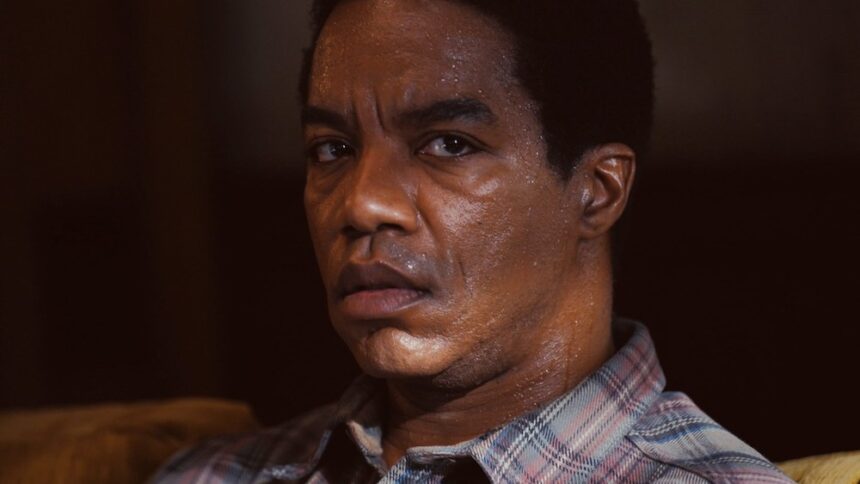
But then, some boys throw bangers nearby, and he finds himself diving for cover under a nearby car, where, in one of the film’s more effectively abstract evocations of a dissociative episode, he watches the slice of pavement visible from his vantage point reverberating to the deafening chaos of explosions and gunfire in his mind. He shows up at the class, lathered in sweat (the sweat-spray and gunshot-squib cost for this film must represent a sizeable portion of its budget) and hesitantly begins to speak. But he is unable to answer the moppet who — in a sentimental, heavily-leaned-into close-up — poses the question that gave Nelson’s original memoir, and gives Tsukamoto’s film, its name.
The film has maybe eight or ten endings — forgive the inexactness, you too may lose track of the number of times you are halfway out of your seat with one arm in the sleeve of your coat, before realizing that no, that very obvious dramatic beat was not the final bow, because now, suddenly Allen has a beard and a daughter! Oh, now his beard is gray. Oh, now he’s on a boat! And here is Lily Franky, the great Japanese actor who is fourth-billed but arrives at the eleventh hour to deliver a single monologue to a closed bathroom door. It is rare to come across a film — especially in a major festival’s competition lineup — in which not only does so little work, it is given such endless acreage in which to keep not working, which is especially striking given that there’s little in “Mr Nelson, Did You Kill People?” that can’t be boiled down to: “Yes, I did.”