



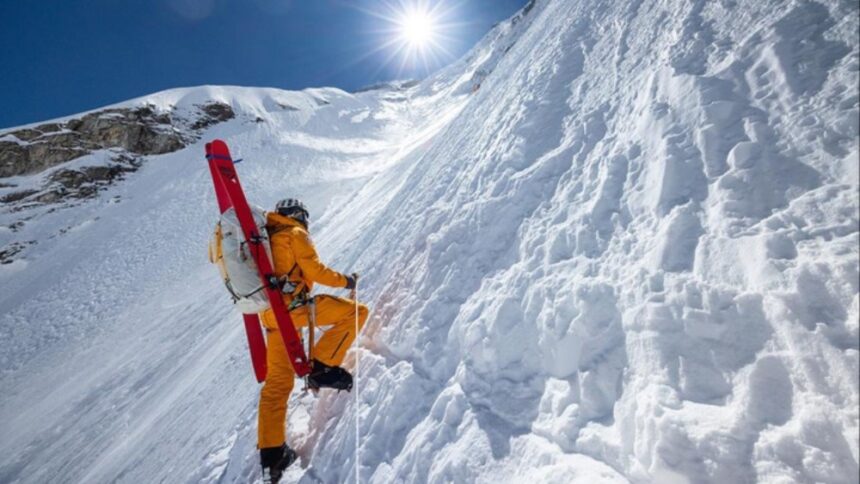
“Because it’s there” is the famous, possibly apocryphal, reply attributed to British mountaineer George Mallory when asked why he wanted to climb Mount Everest. Unlike present-day climber Jim Morrison, Mallory didn’t also want to ski down it. But doesn’t the same non-answer apply? Why are certain people compelled toward any of these reckless, perilous, barely possible feats? If it’s just because they can, should they? These are the questions that will be on the minds of many viewers watching “Everest: The Other Side,” a gleaming, would-be rousing documentary portrait of Morrison, his late partner Hilaree Nelson, and a shared Everest ski-mountaineering dream that wound up taking her life.
But those questions are weakly and only intermittently asked by Elizabeth Chai Vasarhelyi and Jimmy Chin, the formerly married duo who won an Oscar for the giddy spectacle of “Free Solo,” their 2018 film about the similarly ambitious daredevil rock climber Alex Honnold. “Everest: The Other Side” aims for that film’s level of slack-jawed exhilaration: Everest itself is shot with sweeping, reverential grandeur, as it can hardly fail to be; Morrison’s eventual hard-won scaling of it is triumphantly depicted, as is his wild, gliding descent. But it’s hard to thrill to any of this when our minds are on the woman who died attempting to do the same thing, and the children she left behind. To Morrison, as well as to the filmmakers, this awful backstory makes something cathartic of his accomplishment. Many in the audience, however, will query the point of it all.
Nelson, in fact, was more self-searching than the film around her — which began development as a markedly different story, following the couple’s joint thrill-seeking mission with the same degree of awed excitement that colored “Free Solo’s” portrayal of Honnold. “People ask, ‘How do you find the balance,’ and I want to punch them,” says Nelson in interview footage, referring to the conflict she felt between her maternal obligations to her sons Grayden and Quinn, 11 and 13 respectively at the start of filming, and her urge to follow her bliss as a ski-mountaineer, knowing the dangers involved. Later, she resumes the subject: “What I can do is love my kids today when I see them. What else can I do?”
And if you allow yourself to be guided only by the film’s stunning mountain vistas — those vast slopes, the uninterrupted pelt of brilliant snow atop them, the neon-yellow punctuation marks of the men’s tents and gear — and the full-tilt orchestral push of Caroline Ho’s score, you might get caught up in the romantic, near-fantastical folly of the enterprise, as befits a film presented, like much of Vasarhelyi and Chin’s previous work, under the National Geographic documentary banner.