



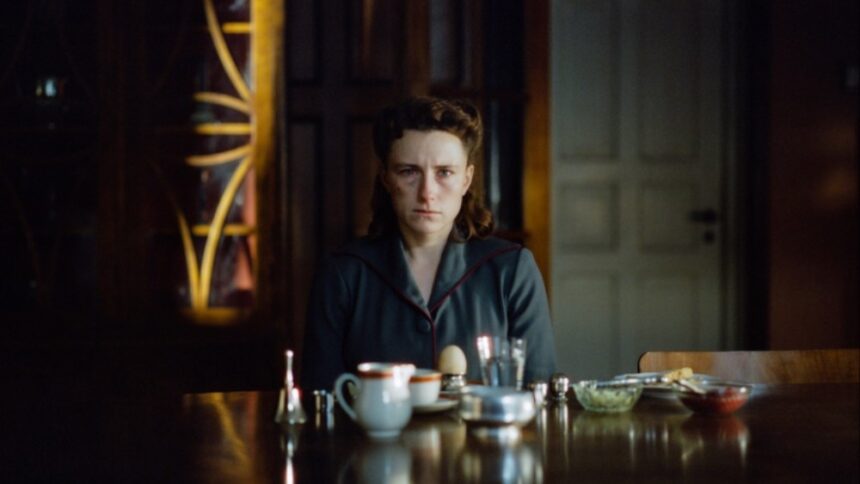
In “Woman Unknown,” May el-Toukhy takes a closer look at women accused of having relationships with German soldiers during World War II.
“When we started to build a story about a ‘horizontal collaborator,’ we realized that, during and after the war, the female body became part of national identity. But in Denmark, it wasn’t really explored.”
Initially, she wanted to make a film about the witch hunts after the Reformation in the 1500s.
“It was difficult to relate to the perpetrators because many of them were just maniac. And I’m interested in ambiguity,” she says. Then, she came across an old newspaper photo of a woman with a swastika painted on her back.
“You can find very similar stories that are thousands of years old. The shaving of a woman’s hair or her public shaming for ‘sharing’ her body is a very old concept. Even today, it’s still happening in many armed conflicts.”
Still, this suffering tends to be ignored by historians. The title of her film references that silence as well.
“I was inspired by Belarusian writer Svetlana Alexievich who wrote ‘The Unwomanly Face of War.’ She gathered these testimonies from women who talked about having their periods in war zones, hiding in sheds, and giving birth. It’s rare to have such recollections of the female experience during or after the war,” says el-Toukhy.
“Our main character wants to remain unknown, but we haven’t told stories about these women either. When you see their photographs in the archives, they’re often labeled ‘unknown woman.’ Also because people didn’t care.”
“Obviously, I’m delighted to have been invited to this historic festival. But I would have loved to be in the company of more female directors in the competition. I do believe it’s a structural problem,” notes el-Toukhy.
What’s the solution?
“Everyone has to chip in and be a part of it. I will now have a chance to discuss this issue through my film, which is rather aptly called ‘Woman Unknown’. I’m happy to do so, even though the circumstances surrounding me being in the main competition are what they are.”
“We have a lot of work to do in order to change that.”
May el-Toukhy is interested in new solutions. As previously announced by Variety, she’s also part of the new Dogma 25 movement. You can find the full manifesto here.
“It’s always healthy to disrupt your process as a filmmaker,” she says.
“It would be a betrayal to my sisters around the world if I only portrayed women as saints. It’s important that we tell stories about complex women in a nuanced way, just as we do with male characters. That rings truer to life.”
She wanted to stick to a female perspective throughout the story.
For the longest time, no one dared to criticize “the liberators” and their brutal methods.
“It would have been harder to tell this story 25 years ago when those generations were still alive. Some audience members will still be shocked or angry because their grandfather was part of the resistance movement, which became very strong in Denmark right up to the liberation. But not everyone should have been a part of it.”
“It’s important to have discussions about what actually happened so that we don’t recreate false narratives. It’s hard to change the direction you’re going in if you’re not looking back.”