

Macron also nodded to the rising tide of political pressure being applied to arts and cultural institutions in Europe, the U.S. and beyond.
“If there is a debate or if it is threatened by some populist parties or some extremes, we have to resist because I think it’s part of what we are. Culture and art is part of what France is. It’s part of our soft power outside and it’s a very important economy as well,” Macron said.
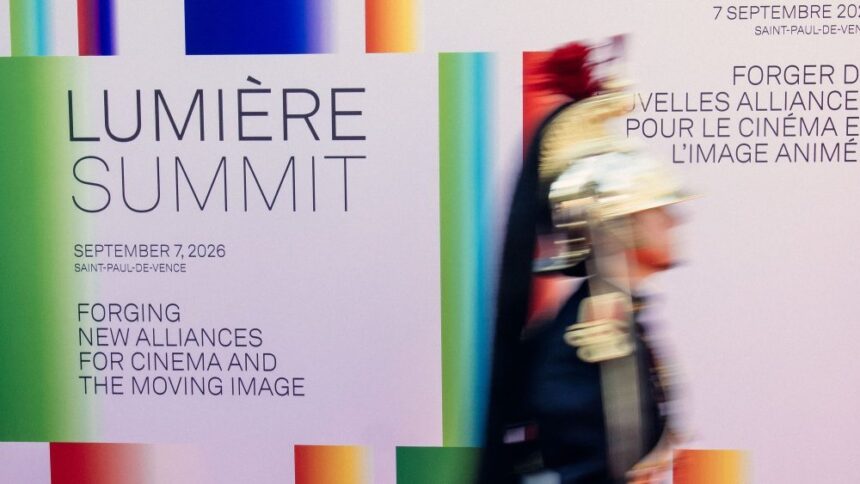
That belief — that culture is simultaneously an economic force, a source of soft power and something that requires active protection — became the thesis for the gathering, the first of this scale in a century. Macron and Lee Jae Myung emphasized the urgency of the need to act as AI tools and
A number of initiatives were unveiled at the event, notably:
** A pact between France and South Korea to build up film, TV, animation and gaming creative sectors, backed by $1.1 billion in investment. 2026 marks 150 years since France and Korea began diplomatic relations.
** In a response to the AI boom, 120 of the Lumiere Summit’s 200 participants endorsed a declaration that pledged to prioritize human creation, copyright and cultural diversity in the artistic process.
Thierry Frémaux, Cannes Film Festival chief, stressed that instruction in media literacy is crucial. “Education for children, for the new generation, for what they have to know about history of cinéma and the history of images, because so much of what they know comes from the internet,” Frémaux said.
For CNC president Gaëtan Bruel, president of France’s CNC, the provocative topics and concerns raised about the long-term effects of online media gave them a good starting point for meaty discussions. Macron appointed Bruel to run France’s national film body in spring 2025. Almost immediately, he asked him to begin organizing a summit devoted to the future of cinema and the moving image. Bruel said the idea grew out of Macron’s concern about “the darker side of our image-saturated civilization” and the increasingly urgent question of how societies relate to screens.
Bruel proposed the Fondation Maeght — France’s first foundation dedicated to modern art — as an intentionally unconventional setting. “The place did not call for convention-center panels; it called for conversations, in the sculpture garden, on the terraces and among the artworks.”
Organizers arranged nearly two dozen panel sessions throughout the day, letting participants choose among six smaller conversations at several points during the day, while leaving room for informal chats in the gardens.
During the outdoor lunch, Macron sat alongside Brigitte Macron amid a mix of political and entertainment heavyweights including Netflix co-CEO Ted Sarandos, Disney’s Dana Walden, NBCUniversal’s Donna Langley, Sony Pictures’ Tom Rothman, George Clooney (fresh off his Venice Golden Lion honor), Paramount Skydance’s Andy Gordon, Mediawan co-founder Pierre-Antoine Capton, Cannes Film Festival President Iris Knobloch and CJ Group’s Miky Lee in gardens of the Fondation Maeght.
Guests ate beneath the trees at long tables set among the foundation’s stone walls and sculptures, making the gathering feel at moments more like an unusually high-powered Riviera garden party than an international policy summit.
YouTube is highly viewed but not subjected to any French production investment obligations because it is not a producer of original content per se. Netflix does face French regulatory curbs on how it operates in the country. Asked about the YouTube effect in France and elsewhere, Sarandos told Variety, “We should all compete on this level. We compete with everyone on the TV screen. So if they’re on the TV screen, they’re a competitor.”
Donna Langley, chairman of NBCUniversal Entertainment, similarly pointed to the significance of bringing together industries and cultures that increasingly face the same technological and economic disruption.
“Yes, we’re in the Hollywood film industry, but we are a global industry,” Langley said. “To be able to come together with different cultures and different countries to tackle some of the biggest challenges that we know we’re going to be facing even more as the future unfolds — whether it’s with AI, new technology, or just the disruption in general — I think it’s very important.”
For SXSW festival artistic director Peter Debruge, one of the more unusual aspects of the summit was seeing that spirit extend even to organizations that typically are ruthlessly competitive.
Macron’s full-throated defense of protecting cultural distinctions also reverberated through discussions about local production, artists’ rights and freedom of expression.
Anonymous Content’s Walker likewise said one of the messages he was taking away was “the importance of elevating and exalting and rewarding artists and standing with them,” particularly amid what he described as growing authoritarianism around the world and threats to artists.
The question of how locally rooted films and programs can travel internationally produced some of the summit’s most concrete conversations.
Sang-Hyun Yoon, CEO of Korea’s CJ ENM, said he met with executives from Canal Plus and France Télévisions about bringing more French content to Korean audiences and more Korean programming to France. “It is difficult to build meaningful global collaboration through the power of content alone,” Sang-Hyun Yoon said. “We also need stronger collaboration among local platforms. If local platforms can work together in this way, I believe that these partnerships between platforms will become another very important element in taking content across borders and accelerating its globalization.”
The debate around theatrical and streaming distribution also surfaced throughout the day.
Andy Gordon, chief strategy officer and chief operating officer for Paramount Skydance, said what distinguished the summit was Macron’s insistence on what should happen next. “I thought it accomplished what President Macron was after. I thought it opened a lot of conversation,” Gordon said. “And as always, he ends every discussion with a follow-up plan, which is unique and special.”