




What works here? Tommy Lee Jones certainly does, in the old Harry Carey role of the wily, philosophical U.S. Marshall who has his eye on Quirt and the Laredo gang. He’s 80 years old, and thankfully Jones hasn’t done anything to look otherwise. But his voice is higher now, and his delivery of even the cardboard-iest of lines offers witty little payoffs. The downside of Jones being the upside of his own movie is simple: There are times when you’d rather be watching a whole movie about this guy.
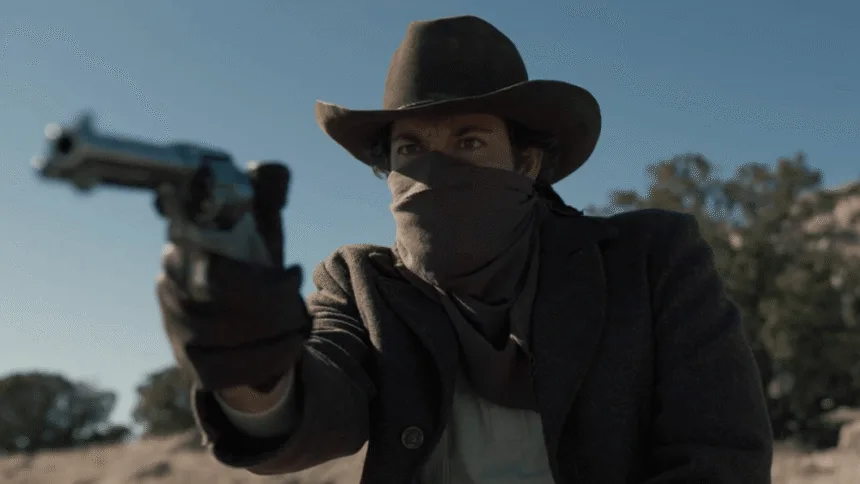
As Quirt, Zachary Levi is, well, a number of different things. A lot of his role, as written, leans into anachronistic wisenheimer mode, with rejoinders like “goodbyes ain’t never really been my thing” or, when rescuing the woman he loves from a fate worse than death, a quippy “Sorry I’m late!” Elsewhere in the film, Quirt must reckon with the legacy of brutality left to him by his father, and by his own livelihood in recent years. Levi can’t reconcile the tonal swings, but he’s proficient, if more in the vein of Jason Sudekis/Ted Lasso than in the creation of dimensional dark angel. (That title always referred to two angels, not one.)
Cinematographer and editor Alex Quintana’s lighting, cutting and shot design — to the degree he worked with the director on the third element — gets the job done without fuss but also without distinction, or surprises. Frustratingly, the first shot of the film is the strongest: a well-judged long-distance view of a lone rider on the horizon, after we’ve heard gunshots from off-screen, soon joined by horsemen in pursuit. We’ve seen a few like it before, but this one’s framed judiciously, and doesn’t look or feel like just another reenactment of a cliche.