





After turning Spain’s tax agency into the unlikely engine of a noir-tinged comedy, “Celeste” creator Diego San José and director Elena Trapé are taking aim at something far more sacred in Spain: soccer.
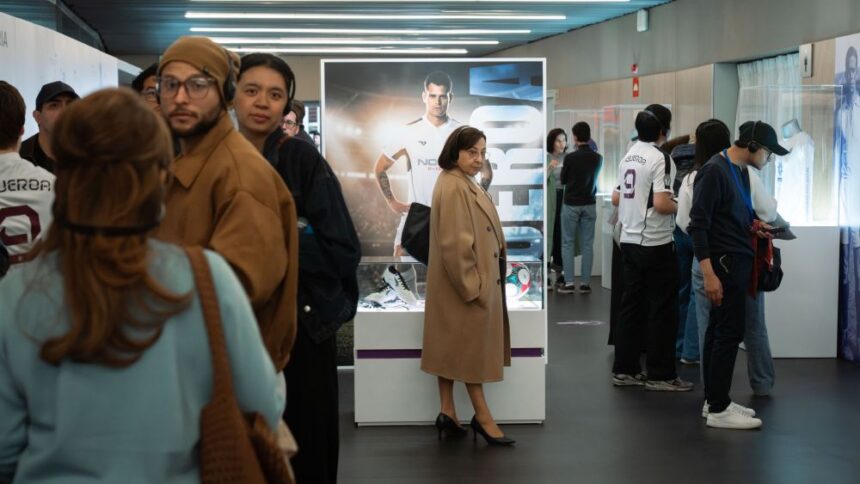
The six-part second season of the Movistar Plus original brings Carmen Machi (“La Mesías”) back as Sara Santano, the tax inspector who spent Season 1 trying to prove that a globe-trotting Latin music star owed €20 million ($22.4 million) in Spain. This time round, the series rewinds to an earlier point in Sara’s career and revisits Figueroa, the Argentine soccer star whose earlier tax case marked the only professional failure of Sara’s otherwise distinguished career.
The social equation flips with him. Sara embodies one of Spain’s least-loved public figures; Figueroa is a soccer idol whose failings can be forgiven as long as he delivers on the pitch.
Season 1 won Spain’s Ondas and Feroz awards for best comedy, while Series Mania’s International Panorama awarded it best series and best actress for Machi last year. It also launched on Arte in France and Flow in Argentina.
Why make Season 2 a prequel and return to the Figueroa case?
If the first season is about solitude, the second is about the end of love — what happens when two people sleep separately, still care for one another, but are no longer in love.
Sara is exemplary, but she also breaks her own rules. What interests you about pushing her across those lines?
San José: Stories become interesting when characters do things they don’t normally do. Sara is an exemplary inspector, but we put her in circumstances where she breaks her own rules.
Even when the characters make questionable choices, the series seems more interested in understanding than judging them. Was that important to you?
All the characters in “Celeste,” on both sides of the investigation, are emotionally broken. I don’t think you can hate somebody who isn’t happy when they go to bed. If things aren’t going well for you, I think an embrace comes more naturally than an elbow.
Elena, how do you convey that emotional vulnerability without tipping into melodrama?
“Celeste” Season 2 Javier Perez Garcia
The series has a particular affinity for losers. What draws you to them?
San José: We all have a losing side, and not everybody has a winning side. What equalizes all of us is that we all know what it is to lose. Defeat is what makes us connect.
The singer Celeste is no longer central to the story. Why keep the title?
San José: We never attached much importance to the title containing the name of the most important character. “Celeste” for us has become almost more of a color than a figure from music.
People even sometimes refer to Carmen Machi as Celeste: “Have you seen that series about the inspector, ‘Celeste’?”
The first season connected with more people than even we expected, so we wanted to keep the same brand.
Elena, after the response to Season 1, what did you want to achieve with the second season?
Trapé: There’s a solidity to this season that I really like. As the characters gain more volume and nuance, and the plot develops, you enter a universe that keeps expanding. It becomes something more mature.
Watching it now, I feel we’ve grown. It feels like a very solid season.
San José: My plan, as a viewer, is for Elena to make something without me, because I’d like to see it. The downside of working with Elena for three or four years is that I don’t get to watch things by Elena.
If Elena wants to make “Yakarta 2,” it will happen. That depends on Elena.
Trapé: What I hope neither of us rules out is working together again. Whether it will be “Yakarta 2” or something else, I don’t know.
San José: I think if Javier Cámara wins the International Emmy, it’s going to be difficult to sit down to dinner without somebody saying, “Why don’t you make a ‘Yakarta 2’?” So let’s make Javier responsible for that.
This interview has been edited and condensed