



Steinbeck’s novel is largely centered around the Hamiltons (who emigrate from Ireland to the author’s beloved Salinas Valley) and the Trasks (who move to California from the East Coast). Why did you choose to cut down the Hamiltons’ storyline and center your adaptation instead around Cathy?
It became clear to me pretty early that if I was going to keep it at eight episodes or fewer, I was not going to have enough real estate for the Hamiltons. It was really important to me that this didn’t turn into a survey course of American history. I really wanted to go deep with these characters. A lot of the Hamilton stuff is quite emotional and deeply meaningful to the greater themes of the book. Tom Hamilton is probably my favorite character in the whole thing. But at a plot level, it’s really episodic. It doesn’t build in a dramatic narrative sense; it doesn’t go someplace the same way that the Trask storyline does. So by the time I got to the fifth episode, I knew that I was going to have to sacrifice that.
There are novels that are all just poetry and emotion and themes, in which nothing happens. I think while an art film can do that, that’s not really what television is for. Even though I was trying to make something really timeless and that maybe stood out from the medium, I was also trying to make a piece of entertainment. One of the things that’s really important to me about the book is that it’s not “high art.” It was a piece of populist entertainment that he was writing, and I really wanted to preserve that.
I know that we’ve talked in the press about this new emphasis on Cathy Ames. That was more in response to the 1965 film, which really sidelines her, than the actual book, which I think is fascinated by her. Cathy is the plot engine of this book. She is the troublemaker. She fascinated me from the start. I’m so curious about her — and I think Steinbeck was too — so I don’t see it as being quite as revisionist as maybe some of the articles have been framing my take as.
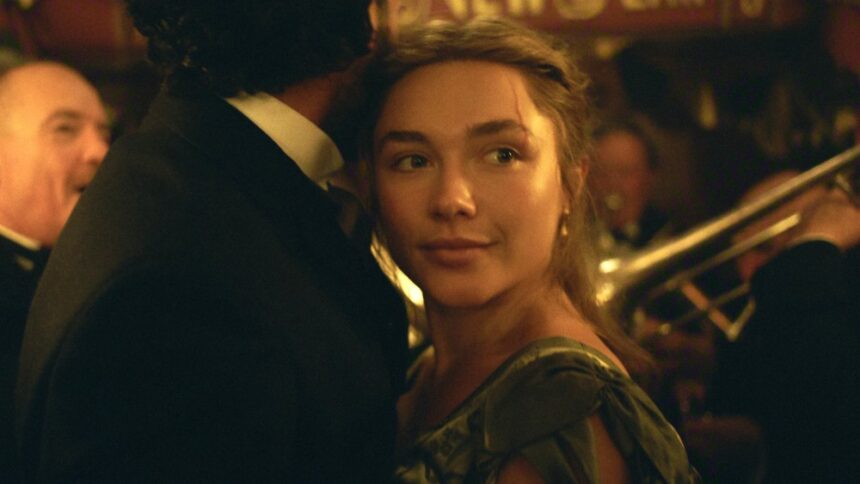
Florence Pugh and Christopher Abbott
Courtesy of Netflix