


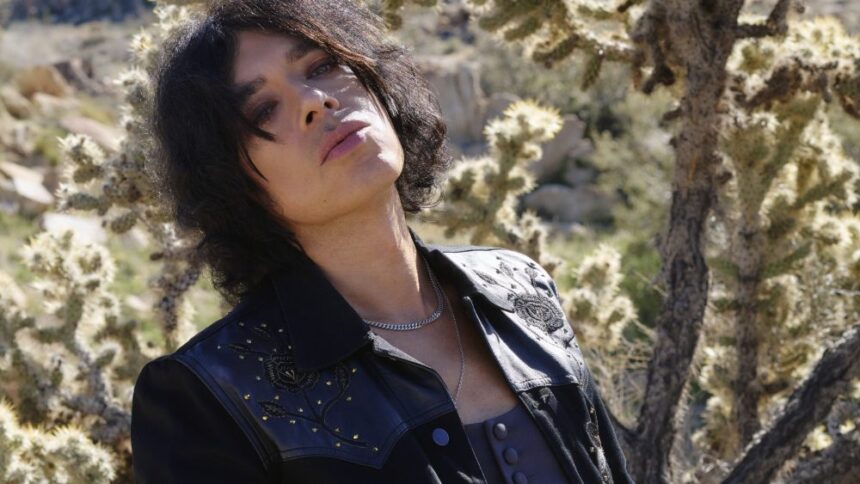
“The Meaning” kicks off Rothman’s new album, “Here Lives Love/Sawdust to Stardust,” which they consider the completion of a trilogy of Americana-rooted albums that tell the story of the singer’s life and career to date. (Rothman suggests the music being formulated for the next album actually has more of a jazz flavor, though they’re convinced that belongs as much in Americana as the acoustic singer/songwriter material being emphasized at present.)
During the recent AmericanaFest in Nashville, Variety sat down to talk with Rothman not just about wrapping up the fruitful trilogy with “Here Lives Love/Sawdust to Stardust” but about a rich and growing side career producing other artists, including Amanda Shires‘ 2025 confessional album “Nobody’s Girl” (and “Take It Like a Man” before it), Maggie Rose‘s vivacious “Half Moon” and Tift Merritt‘s comeback, “Sugar.” When Rothman begins the new album asking the most core question of them all, “Why am I breathing?,” any of these albums — the ones produced for others, and their own new one — offers a substantial and worthy enough answer.
Lawrence Rothman
Mary Rozzi
How do you make yourself “part of the band”? Is that literally through playing an instrument as part of the sessions?
Like I said, I like to be immersive with it, and I don’t want to feel like I’m the producer behind the glass. I stand in the recording room, not the control room, when I’m producing. If a singer’s singing, I’m right next to them. Sometimes I’ll take my shirt off and dance. I’ll do whatever it takes to get it to have an energy. Because there’s something so clinical, almost like a doctor, about being behind a glass, and they’re in the distance — it just feels odd to me. So I’ve never been one to not just immerse myself physically in the room. If I’m not playing something, I’m tapping something or just getting people to get going.
You’ve talked with liking having women’s voices on your own albums…
I like to frame my voice. My voice is so low that a woman’s texture, or that range, always complements my voice well. So for this record, I have Amanda and Jillian Jacqueline and Katie Pruitt singing on some song, and I got to sing with Sarah Klang (as a duet on “A Fire Test”).
The artists we were just talking about you producing recently — Amanda, Maggie, Tift — are all women. Not that that would be solely your focus, but do you find you gravitate toward women artists more than others?
Yeah, I don’t look at it like that at all. I have to just love the music. And I’m not doing producing to become a millionaire of any sort. I’m doing it because I want to help this singer express what they’re doing in a way that feels like, are we pushing the envelope in some direction that’s forward? And with Americana music, funny enough, I think it’s the most forward-thinking music of any genre right now — because you can be R&B, you can be rock ‘n’ roll, singer-songwriter, folk, you can even be a little bit jazz, and it’s all accepted in the community of Americana. And I think the term Americana is being reinvented as different than what it started as. and now it’s the place for people who want to take all the styles that have sort of, I guess, begun in America or become more mainstream through American culture, and mashing them up to be something that’s uniquely its own.
I think some of the freshest and most exciting music I’ve heard in the last five years has come out of the Americana quote-unquote “scene.” So I find myself working and producing a lot of artists that are under that umbrella. But to me, they’re also all, like, either a rock ‘n’ roll artist or someone like Maggie Rose, who is like soul meets singer-songwriter. So when you’re asking me about, is it women, or… For me, I think right now it’s that it has to resonate in a way that’s pushing genre forward. And if we’re gonna still use use those genre terms like Americana, pop and alt rock, Americana is the place where I feel like you can kind of be anything. I wouldn’t be shocked if somebody put out a space-dance-country-folk record. You can kind of be anything in it and you’re welcomed into the party, as long as the thing that ties it together is the music’s played by real people. There’s great lyrics, whether it’s storytelling or more abstract. And I’m not anti-AI, but I feel like gives the identity to Americana music is that humans created it all. It’s the human touch music.
You have come to feel very comfortable in Americana, though it’s not at all where you started. And with your new album being pretty acoustic, you’re pretty in the pocket with that at the moment.
Yeah, the last three albums, I’ve pretty much focused on that, and that’s been the community that’s welcomed me, so it’s the one I want to identify myself with and support. But if I want to go make a jazz record for the next one, I’m gonna go make it. If it’s called jazz or Americana, I don’t really care. It’s come up a lot that it’s been hard to label what I do, and that’s fine with me. I love Beck, and Beck’s hard to label as well. David Bowie, I don’t even know what the label of that music would be, you know?. He started as a folk artist, and then was a rocker, and then was a pop star, and then was kind of an abstraction star.
Lawrence Rothman
Mary Rozzi
For Bowie with “Blackstar,” obviously that was cathartic to write about death because he was dying. With “The Meaning,” I wrote about, why am I putting this album out right now? Why am I doing this music? I’m doing it because it’s my primal scream. It’s my therapy.
So the start of the trilogy was with that idea, and I connected with Lucinda Williams, who has been a huge influence on my life on every level. On that record, she sang with me on a song called “Decent Man,” and that brought me to Nashville. I’d come here as a kid to record, I fell back in love with the city and the scene, and then that record just sort of dictated where I was gonna go. I started writing more songs from that record that appeared on the last record, “The Plow That Broke the Plains,” and then a few of those songs I wrote during that period have appeared now on this one. I brought back some of the same collaborators throughout the three records. Katie Pruitt is on the first one, and now she’s on the last one with me. Amanda Shires is on all three. And Jason Isbell is on the last one and the new one. We wrote a song called “Nothing Like Shakespeare” together in the same three hours that we wrote a song off my last record called “Poster Child.”
Is it a cathartic story, overall?
You know, it’s been a painful experience being in music, I’m not gonna lie. But it’s something that I can’t live without. Every time through the years that I’ve gone “I give up,” the next morning I wake up and I’m at the piano or guitar. My wife laughs at me about it because I give up, like, once a year. But I can’t get away from it. I’ve been on stage playing music since I was 8 years old; got my first record deal at 16. And it has more to do with the act of creation than it has to do with the fame or the fortune. I always say to my wife, “You can’t have a little hallelujah without a little hell.”
I don’t think I can really write stories about other people. Unless it’s a friend of mine and I’m observing it, it has to be something connected to me. Those types of writers that can just kind of observe from afar and write about it, that to me is more like work, and I can do that for other people, because I write a lot for other people. But for me, when I’m writing my own songs, if there’s not some weight behind it that’s resonant with my real life, I feel like it’s empty words. So it’ll always be autobiographical, I think. But hopefully, next time, I’m thinking it’s gonna be happy. Maybe I’ll have my Bobby McFerrin moment, you know?
Going back to the song “The Meaning,” a press release said you were donating proceeds to the Trevor Project. Why that cause?
You look like a rock star now, but if that’s how you looked growing up, there are reasons to understand why that might not have been the popular thing. Missouri is not the rock star milieu.
It was a lot of shit. You know, my mom was always the type of person where it’s like, “Be you. You’re an individual. Be yourself.” And I could wear a dress; I could wear a cowboy hat and no shirt with cut-off jean shorts if I wanted. She didn’t give a shit. I could put makeup on, do whatever I wanted to do, so I was always super eccentric. Back then, the word everybody would use was “androgynous.” That was how I was defined in the ’90s growing up, is like, “Oh, that’s the androgynous kid.” Growing up in Missouri, and you get a lot of heat for being not an athlete or at least dressing like an athlete.
To ask about another song on the new album, “Worn Out Woman” — was that inspired by anyone in particular?
About another new song, “A Word’s a Weapon” — was that prompted by contemporary discourse?