




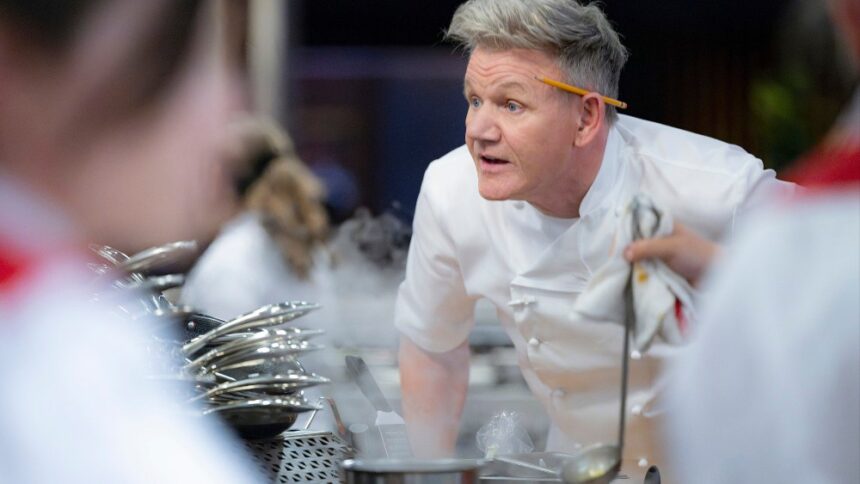
Gordon Ramsay is on set in Ireland when we speak. It’s a hot, sunny day but he is surrounded by Christmas trees and elves as he’s shooting the “Next Level Baker” holiday special for Fox.
It’s very festive, which seems appropriate as he’s recently uncorked the 25th season of “Hell’s Kitchen,” and earlier this year unwrapped the 10th season of “Kitchen Nightmares,” while also serving up the 16th season of the U.S. version of “MasterChef.”
But despite the continued popularity of his shows, reinforced by the Netflix series about him, some in the industry are starting to ask: Have TV audiences started to lose their appetite for food shows?
“The Heat” is set in a real restaurant in sun-drenched Barcelona where a group of young chefs battle it out under the supervision of a world-class Michelin chef. “The chefs are working together during the day and they’re competing, but they’re also living together at night; so they’re working hard and they’re partying hard,” Clark explains.
“And what that means is the stress and the ambition for winning the cooking contest meets the relationships and the night lives that go alongside of that. What you then see is the romances, the rivalries, the flirtations, the fallouts — they all make their way back into the kitchen in the daytime.”
“The Heat” was a blend of cooking contest and dating show.
“The Heat” (Courtesy of ITV Studios)
Ramsay attributes the popularity of his own shows to their “live aspect,” and underscores the need to “keep things incredibly fresh.” Referring to “Hell’s Kitchen,” he says, “There’s a format, but each and every season, we rip up the rule book and rewrite the challenges.”
The secret to its success, Ramsay says, is that he runs it like a live restaurant. “There is something magical about going into the unknown when that first ticket arrives. We train and train and train those individuals, put them through this incredible boot camp before we go live, and each and every night is a live performance, like you’d go to see in a theater,” he says.
Lucas Green, chief content officer, operations, at Banijay Entertainment, another global TV distribution and production titan, acknowledges there has been a shift in audience tastes as food content on social media proliferates. “People love watching recipes and food porn on Instagram and TikTok, and I think that’s probably replaced the instructional cooking shows,” he says.
“MasterChef” was the most adapted format in the world last year.
Courtesy of Banijay
“[‘MasterChef’ has] got that light-touch reality storyline with people coming back week to week, and they’re very, very determined to win,” he says. “[The show] changes people’s lives. Lots of winners have gone on to get Michelin stars. It’s very aspirational.”
The blending in of a story arc boosts the audience’s desire for more, encouraging binge-viewing, says Mike Beale, managing director, creative network, at ITV Studios, which has “Hell’s Kitchen” on air in 26 territories and “Come Dine With Me” in 50. “You need to take the viewer from one episode to another. Just seeing five people cook, and there’s one winner at the end of the competition, and then next week, you do the same competition again with five new people, isn’t going to do that anymore,” Beale says. “It has to hook you in and take you there, and streaming has driven that behavior.”
Meanwhile, the networks continue to bring new zest to old favorites, such as the launch last year of “Gordon Ramsay’s Secret Service” on Fox, reinventing the “Kitchen Nightmares” formula, Olivier Levet at TV consultancy The Wit says.
Joshua Weissman
Courtesy of Michael Loccisano/Getty Images for NYCWFF
Meanwhile, Levet notes that the streamers have developed their own taste for cookery shows like “Dinner Time Live With David Chang,” “Culinary Class Wars,” “Iron Chef: Quest for an Iron Legend” and “The Final Table” on Netflix, and “The World Cook” on Prime Video.
And online and linear can feed off each other, Green argues. “MasterChef” has a spin-off in Brazil, “MasterChef Creators,” which streams on YouTube, and casts only digital influencers, which has brought a younger audience to the show.
Whatever exotic recipes the latest generation of celebrity chefs throw together, for Ramsay, his approach is simple, “I suppose I just work at keeping it fresh, and I take criticism, but I don’t sit there and self-absorb and self-obsess about how good we are. I treat every season like it’s the first.”
And sometimes the greatest drama stirred up by Ramsay’s shows occurs after they have aired, he observes, and it’s down to a mistaken view of the realities of running a restaurant.
Referring to some misguided folk on “Kitchen Nightmares,” he says, “The biggest issue I’ve got is when the program goes out and they get that fanfare and attention, especially in the media. They then get a little bit carried away with the fame. And there’s nothing famous in running a restaurant. It’s hard, brutal work that needs to be disciplined and focused on, so you can’t start indulging in success by running a restaurant and sitting down with customers and having the odd glass of champagne or drinking a martini before you start running your dining room.”