



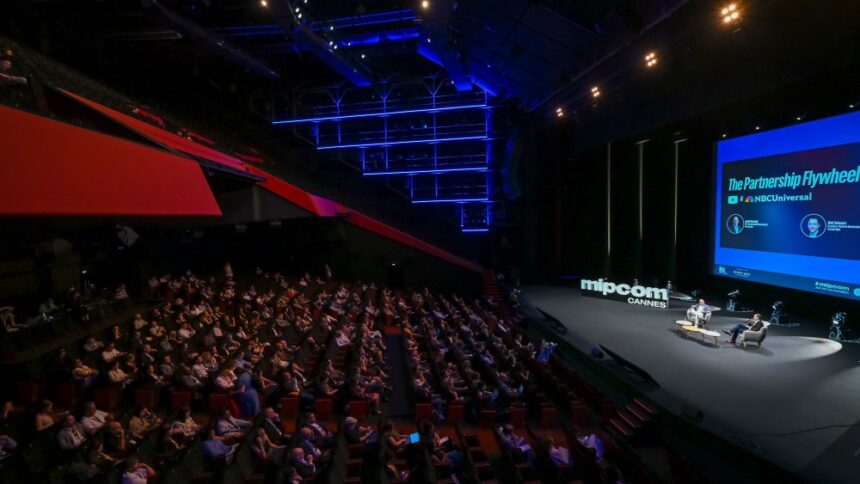
This was one of the dominant themes that emerged in four whirlwind days of panel sessions, closed door meetings, networking and schmoozing events up and down the Croisette as top industry players from Europe and beyond gathered in Cannes for the annual Mipcom content market and conference.
At the same time, Shapiro pointed to hope on the horizon for legacy media outlets.
“We believed television would be replaced by streaming 1 for 1 — that didn’t happen,” he said. Streaming and social video have augmented viewing time and even more important, they help deepen fan connection to their favorite shows. Shapiro emphasized more than once that media giants courting audiences need to think in terms of generations and affinity groups, not the age and gender demos of yore.
“Now consumers have an infinite number of channels. Every human with a phone is a channel,” Shapiro said. It’s the age of “personalized television through a combination of your phone and your television set.”
Matt Schnaars, president of platform distribution and partnerships for NBCUniversal, reinforced Shapiro’s observations in a separate session.
“The embracing of social media platforms, starting with YouTube, to drive people back to live viewing, we see that in results. We see that in audiences,” Schnaars said. “When we look at YouTube … [they] are an example of somebody who’s in really every business that we’re in, but not in a way that’s competitive. It’s accretive and incremental. And so we get excited.”
NBCUniversal is windowing some of its most prized, fan-favorite content – college football – on YouTube. The Peacock streaming platform shares its weekly exclusive games on YouTube. In the old days, that would have been unheard of. Today, it’s about reaching fans where they live. Peacock earlier this year struck an innovative distribution pact to be bundled as part of a YouTube TV premium tier.
“It can build habituation, and then ultimately, hopefully, a purchase of Peacock or going to YouTube TV even to go experience the full slate,” Schnaars said.
Like NBCU, the BBC sees enormous potential in the Beeb’s experiments to date with the FAST channels that are fast becoming a new form of syndication.
“YouTube for me is exciting because it’s where a lot of the audience are now,” said Kate Phillips, chief content officer at BBC Studios. She noted that the Beeb now has 34channels on YouTube, increasing to 50 by the end of 2028.
“We only win when our partners win,” Connolly said.
Here are other trends and themes that emerged from this year’s conference:
Consolidation
As Hollywood grapples with consolidation, cost-cutting and a slowdown in production, French entertainment giants are seizing the opportunity to expand their footprint in the U.S., either through acquisitions or by exploring new investments.
Latin America’s Growth Spurt
Beyond microdramas, where on earth can growth come from in the current TV landscape? With a swing to far-right populism, local production is being put through a political grinder, first in Javier Milei’s Argentina who decimated public-sector subsidies. Now Brazilian cinema is at risk. As a market, however, Latin America paints a different picture. The region is forecast to grow by 15.4% to $62 billion in revenues, exceeding the U.S. growth rate of 10.2%, Omdia’s María Rua Aguete, announced at Mipcom, presenting research and calling Latin America “one of the most exciting growth opportunities in global media and entertainment.” The driver?: online video, led by Netflix. The challenge? Connectivity.
Global Political Peril
France Télévisions has forged a major partnership with YouTube, where its franceinfo news channel generated 110 million views in September, eight times its audience a year earlier. In Germany, ARD’s Tagesschau and ZDF’s ZDFheute are also distributing news on YouTube and developing formats aimed at younger viewers.
Creators Gonna Create
True Crime is Killing it