




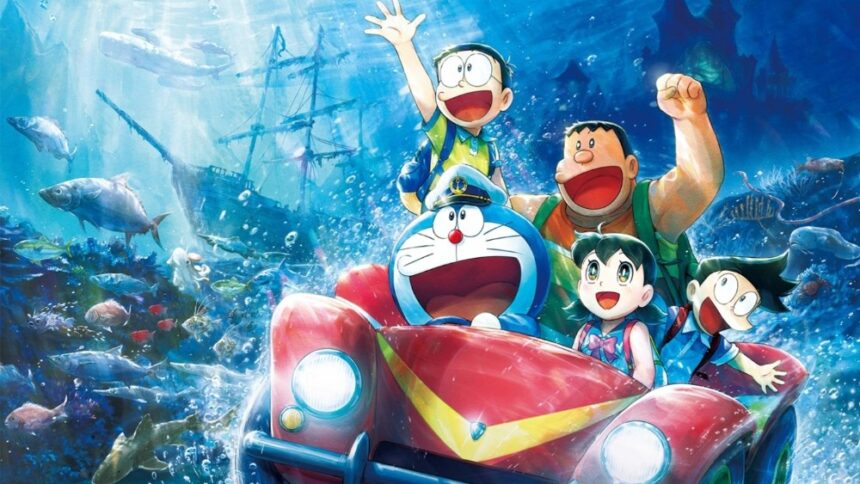
The language strategy comes straight from television, where “Doraemon” has long reached what Sumida calls “our little ‘Doraemon’ fans” in Hindi, Tamil and Telugu. “We wanted to keep it that way for the theater release,” she says.
The film itself reworks a story that first reached Japanese cinemas in 1983.
“I wanted to do it because the original is exactly the same age as I am. Just kidding,” says Nakajima Susumu, chief producer of the film at Shin-Ei Animation.
The visuals are a different matter. Audiences have grown far more discerning, Nakajima says, with a vast number of works now out in the world, and the range of what animators can express has widened considerably in 40 years. The production leans on CG and compositing, yet Nakajima says that “it might sound counterintuitive, but we also cherish the charm of hand-drawn animation – that sort of ‘fluctuation’ or analog warmth.”
Undersea settings are no longer the novelty they may have been in 1983. What sets this story apart, Nakajima says, is that Nobita, a human, ends up beneath the waves because he was bathed in the glow of the Adaptation Ray. “Therefore, we aimed to create visuals that consciously differentiate our work, particularly in how the underwater world looks and the colors used from the moment he is bathed in the ray and thereafter.”
Scale brings its own problem. A “Doraemon” movie has to be bigger than a television episode without losing the characters audiences know.
The five core characters behave as they always do, he says. It’s their circumstances that change, which makes Nobita’s words easier to relate to and Gian’s actions more dependable.
At Fujiko Pro, the work begins with Fujimoto himself. “Even if times change, the essence of children remains unchanged,” says Yoshida Kenji, a corporate officer at the office. Adults, Yoshida says, drift away from a child’s heart as their perspective rises, and end up depicting their idea of what a child should be. “That is why Fujimoto-sensei confronted the child’s heart within himself and brought that child into his works.”
That conviction shapes how Fujiko Pro handles the property. Yoshida says the office does not intend to “evolve” Fujimoto’s work. “That is because we believe the world he created has universal value – one that is loved across eras and borders,” he says.