

Andrew Garfield found the Norman Bates of Silicon Valley, and he could win an Oscar for it.
Artificial
Courtesy of NYFF
To be clear, nobody is accusing Altman of keeping his mother in the fruit cellar (at least not today). The comparison is about the craft and how Garfield approaches the character. Perkins understood that Norman only works if the audience likes him: He stammers, fusses over sandwiches and chews candy corn while chatting with a private detective. Garfield builds his Altman the same way. Sitting almost constantly crisscross-applesauce, his voice stays soft, as his eyes get wide and he listens intently, as if he’s completely fixated on the human being in front of him. Until, suddenly, the life drains from his eyes, sometimes for barely a second, and returning before anyone else in the scene notices. But the audience does. And that’s when you realize the movie has been giving you all the clues you need to recognize the monster you’ve been spending time with, and it reveals himself by the end credits.
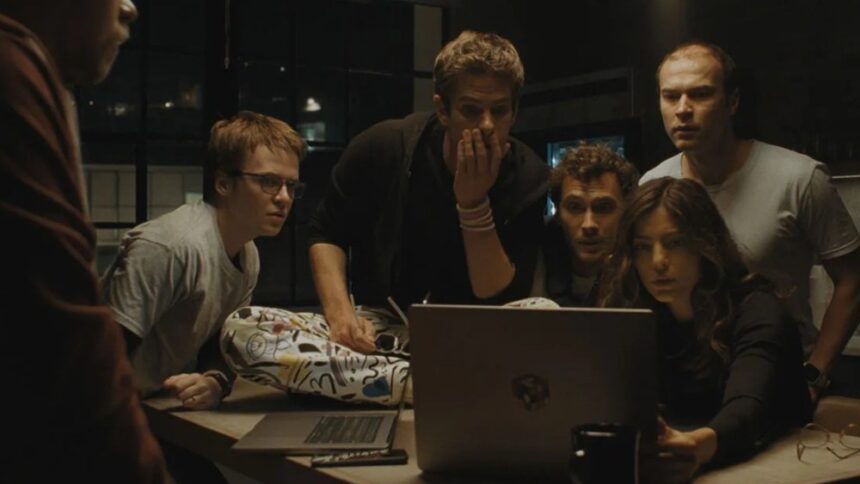
Borisov, an Oscar nominee for “Anora” (2024), delivers an impeccably strong turn. The unknown breakout of Sean Baker’s best picture winner probably wasn’t expected to return this strongly so soon after. Yet here he stands, thought-provoking and stoic, with a turn that recalls someone like Mark Ruffalo in “Spotlight.” He stands as one of the film’s greatest strengths and deserves a spot in the ever-so-crowded best actor field. The talented ensemble around Borisov and Garfield helps, including Cooper Hoffman as Greg Brockman, the loud, obnoxious board chairman and Oscar nominee Monica Barbaro (“A Complete Unknown”) as Mira Murati, the chief technology officer who sees the company’s pitfalls coming.
Andrew Garfield in “Artificial”
Neon
“Psycho” concludes on Perkins’ smile, and interestingly, “Artificial” does on Garfield’s. Let’s see if his smile is repeated on the Dolby Theatre stage.