



At a time when AI is increasingly being used to replace human creativity, “Just Dance” is refusing to change its hands-on approach.
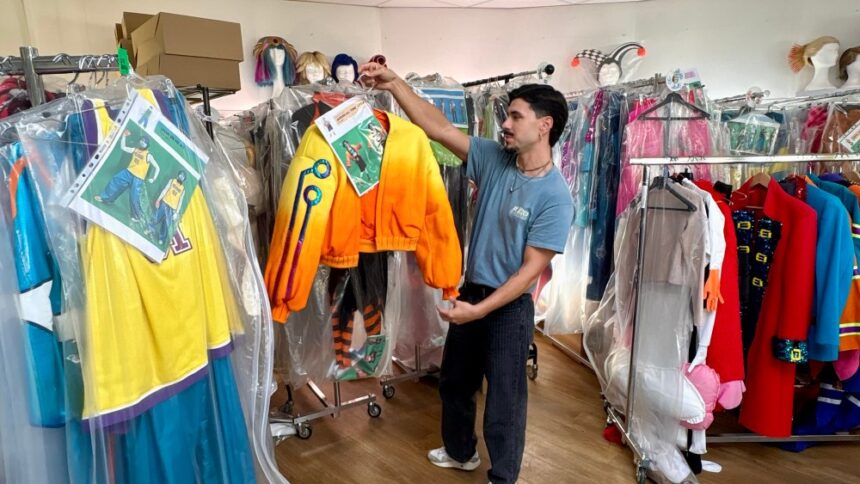
Jouffret says his team is committed to creating its characters without AI. Having studied fashion and previously working as a stylist, Jouffret has spent the past eight years overseeing the costumes and characters that appear on-screen.
The process begins with a brainstorming session, during which the creative team listens to a song and watches its music video to determine the direction of a character. Sometimes the team draws inspiration directly from the artist, other times opting to take the concept in a completely different direction.
The concept art and finished product for Zara Larsson’s “Midnight Sun” for “Just Dance: Decades of Hits.”
From there, the team determines whether the dance will feature a solo performer or a duo or trio, as well as the type of character that fits best. Sometimes, up to 10 characters will be featured in one dance.
“We also decide if you want a casual costume, or an alien or a mascot or a nonbinary character,” Joufrett says. “We do a lot of things.”
His team then assembles mood boards using references from films, music videos and other media before developing sketches and finalizing designs. Once a concept is approved, the team consults its roster of dancers to find someone who can embody the character and complement the choreographer’s vision.
Overall, the timeline is relatively short. After a one-day brainstorming session, the team typically spends two to three weeks designing a character, followed by roughly four weeks of production. That period includes fittings, hair and makeup tests and rehearsals to ensure the costumes work with the choreography. Filming takes place over a single day.
The sketch and final product of the costume for Bad Bunny’s “Nuevayol” in “Just Dance: Decades of Hits.”
“We can’t make beautiful costumes if they can’t be used by the dancers,” Jouffret explains. “We can do what we want, but we have to do it smartly.”
The team previously experimented with 3D printing, but the materials proved too heavy for dancers to move comfortably in. Today, that technique is reserved for accessories requiring smaller, intricate details.
For Jouffret, the trial and error of the process is part of what makes the game so special. “We really love to create and make things by ourselves,” he says.
The sketch for the costume for Billy Joel’s “Uptown Girl” in “Just Dance: Decades of Hits.”
His team collaborates with costume makers and other specialists, each bringing expertise in areas such as mascots, corsets and casual wear. The team’s commitment to representation is also reflected in the game itself, which features dancers with different backgrounds and abilities. In one installment, the team worked with dancer Jana Bruno, who has one arm, earning recognition for its diversity efforts.
Meanwhile, hundreds of costumes from the franchise’s 17-year history remain in storage in Paris, forming a physical archive of the work behind the game’s characters. Jouffret says the team hopes to showcase the creations through a potential exhibition or runway presentation, although some pieces would need repairs after the wear and tear of filming.