





There won’t be a dry eye in the house when this goes wide, as the cliche goes, but there also won’t be an untickled funny bone, given a performance by Scott that’s almost as drolly funny as it is passionate and heartrending (with no small help from writer Stephen Beresford). And there won’t be any un-warmed hearts among any viewers with a deep love for the life of the theater, since the movie serves as a love letter to stagecraft and community, on top of of most obviously being an ode to the seeming indomitability of Charleson as he bravely forestalled his final bow.
Stone’s long history as an actor before he became a premier stage director in Australia and then London — before finally moving into film — deeply informs every legit-loving moment of “Elsinore.” Variety spoke with him the day after his new film unspooled in Telluride, where he enjoyed a crowd waiting to give him and Scott yet another ovation in the lobby, some time after the credits rolled. Under his direction, Scott is an instant contender in the best actor face, and Stone may be up for some contending himself.
You told the crowd at the premiere that “Elsinore” was hot off the presses. How recent was it?

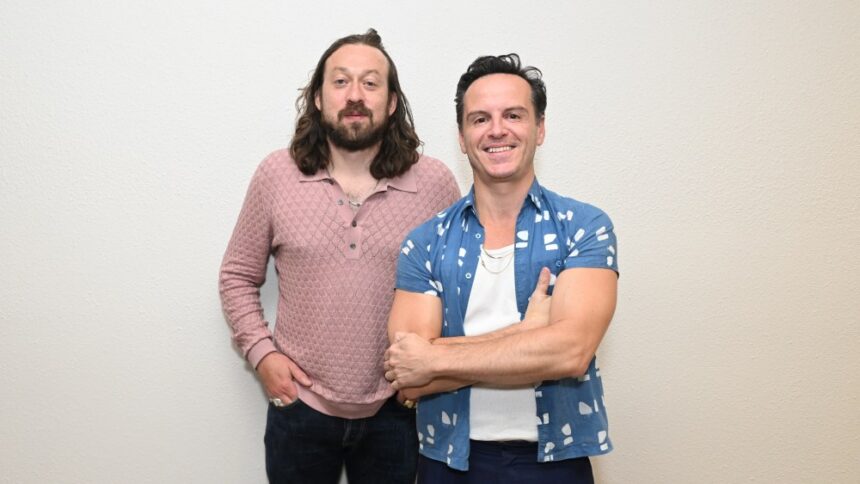
‘Elsinore’ director Simon Stone at the Telluride Film Festival
Chris Willman/Variety
What were the other actors in the “Hamlet” scenes told about the story or about what to do?
They knew the backstory because in London, Ian’s story is one of those myths that is really meaningful, and a lot of his friends were in the film. And it’s a love letter to what theater is — it’s right there. They all wanted to do that, and to make it genuine, as opposed to like… You see so many depictions of theater as this over-the-top, self-centered, performative thing, and I wanted to show it as a crucible, as a shelter, as a safe place.
Andrew Scott stars as Ian Charleson, who was dying of AIDS while playing Hamlet, in ELSINORE.
Credit: Anthony Dickenson / © 2026 FOCUS FEATURES LLC
Anthony Dickenson
There is a scene when Ian starts coming clean about his illness with the rest of the “Hamlet” cast, and a viewer might wonder if, in a scene like that, there will be one token person who seems uncomfortable after learning he has AIDS, but they appear uniformly supportive. It does show what theater buffs hope the inner theater community is really like.
That’s right. I also think the theater community is a group of outsiders. It’s a bunch of freaks and geeks, and the reason we got into it was to share a common humanity, despite not being an average human being. There are a lot of parallels with the gay community at that time, and there is a distinct overlap, obviously. There are a lot of gay kids that ended up in theater because it was a place to express things that they felt that they couldn’t express elsewhere. So I think it’s a kind of rallying cry for acceptance and truth. And when we screened it last night, so many people were so heartfelt in really trying to express how moved they were by having felt seen or having felt someone in their life was seen by this film. That’s worth a million reviews or a million articles. It’s just a single person saying “That meant so much to me,” and I think Ian would feel really happy that that’s his legacy.
You must know what you’ve got on your hands. Did you expect the kind of reaction you’ve gotten in Telluride?
Where do you think we’re at now in terms of people doing stories about “the AIDS era”? In terms of major films, it’s receded a bit.
I also think that it’s because unless you’re in certain parts of the Third World, you’re not dealing with the idea of fatality if you get an HIV diagnosis. So all of these things mean that it kind of becomes less immediately relevant or immediately urgent. But that doesn’t mean that it doesn’t represent all sorts of lessons that we can learn about ourselves now. And I think that what’s great about this film is that AIDS is a context in the film. It’s a situation. In the same way that Martin’s film (Martin McDonagh’s “Wild Horse Nine,” also showing in Telluride) is (set) in the ’70s…. The idea of American intervention in overseas political environments, that’s a context. But at the same time, (“Wild Horse Nine”) is a conversation about what happens when arrogant white men think that they can tell other people how to live, and that then suddenly feels relevant to now.
And I think that we found an equivalent thing with this. AIDS is a context, but it’s a conversation about divisiveness in communities, about the endless attempts to separate ourselves from each other and to create taboos in minority communities about what’s acceptable and what’s not acceptable. And I think that this film is is about: stop looking for everything that’s different about you and find something that’s similar. Find the common ground. Ian did that so beautifully in his life.
Dealing with a terminal illness is closer to universal than not. People die unexpectedly, of course, too, but for the most part…
Yeah facing the end of life is a pretty common thing. The beauty of what he does in the movie is that he looks into the abyss and he finds hope. And weirdly, I was talking to some people where it was like, “Last night I was crying my eyes out, but today I feel really good.” I was like, that’s a common response to people who watch the film, because it’s true catharsis. It’s like a good session with your therapist. It’s like, yeah, it was painful to witness for a second, but at the end of the day, what it gave you was hope, and that’s a great thing to have. Because he faced the end willingly and with beauty, and that grace is extraordinary.
You said it was Andrew’s performance that put Focus into a hurry in wanting to get this out at a premium time this fall. What does his work on this mean to you, as his director?