



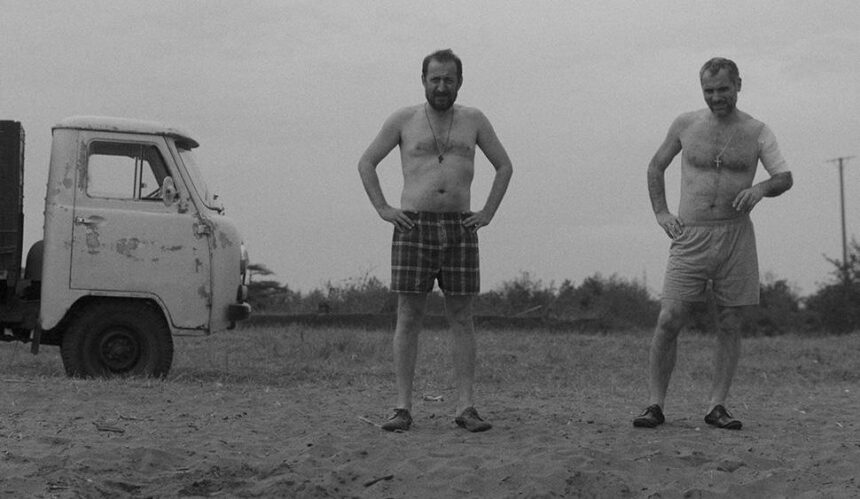
Levan Koguashvili‘s “Guria” will world premiere in Venice’s Spotlight section on Sept. 9. The black-and-white tragicomedy, set in the western Georgian Guria region, follows Zuriko, a 45-year-old widower and farmer as he struggles to find love, as well as a fair price on hazelnuts.
“Guria” is a co-production between Georgia‘s Kino Iberica, Switzerland’s Cineworx, Luxembourg’s Tarantula and Bulgaria’s ArtFest, with support reaching further afield, including Turkey’s Ministry of Culture and Tourism, Norway’s SoRFond Film Fund and Saudi Arabia’s Red Sea Fund.
It’s the director’s fourth feature, following “Street Days” (2010), winner of a Tiger Award at Rotterdam; “Blind Dates” (2013), which scooped the Special Jury Award at Abu Dhabi, and “Brighton 4th” (2021), which took prizes at Tribeca and Cottbus. “Guria” was written by Koguashvili with Boris Frumin, a former professor and longtime collaborator.
This project is a seven-country co-production with global financing. Can you discuss how Guria came to interest so many parties in telling a Georgian story?
Can you talk about co-writing the film? What did that collaboration look like, and what did each of you bring to the story?
What about Georgia and Guria in the ’90s make it the time and place to anchor this story? What has changed about that world?
Koguashvili: Several things, maybe, but mostly, this is how I see life. I don’t see even tragic moments as complete tragedy; life is always full of dimensions. By introducing irony and humor, you don’t make a tragic story less tragic. It just gets a different feeling, it becomes more human, and it’s easier to digest. It also gives the story a kind of lightness and lyricism, which I love. I believe tragedy and drama have to be told with some comedy in them. You try to find levity or humor even in the darkest, most dramatic situation. It’s also a way of working against cliché: when you think of the ’90s in a post-Soviet country, you picture a very dark movie, right? But I think that’s become a cliché too, and working against it is its own challenge. Also, Georgian character isn’t simple. Georgian life in that period was extremely difficult, but there was also a kind of absurdity to it, even a charm. So many things, but usually the films I love have that quality. They’re all comedies about tragedies. It’s a very tragic story, but the telling of it is full of comedy.
How did you come to use singing and song as such an important narrative tool in Guria? Can you talk about the songs the characters sing through the film?