





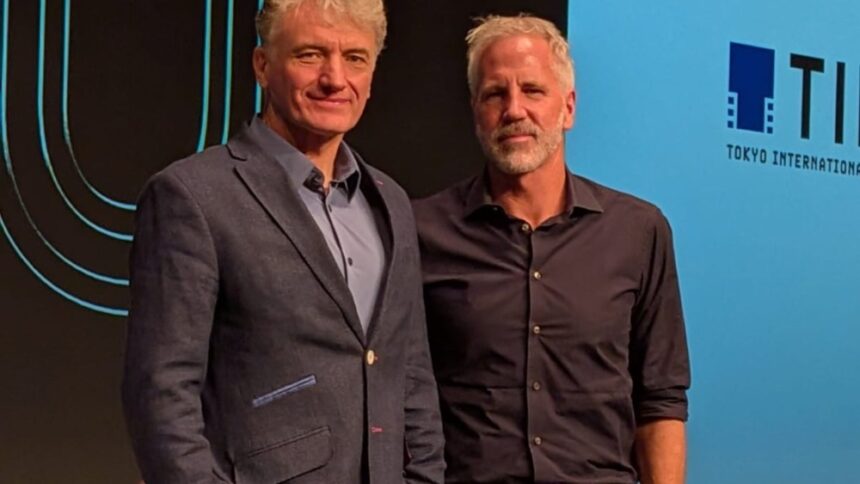
Top AGBO execs Chris Brearton and Dominic Hughes delivered a keynote discussion at TIFFCOM, the content market of the Tokyo International Film Festival, on Thursday, about how AI is impacting filmmaking, how it can be used to assist rather than replace human creators and how it will shape the future of visual content creation.
Hughes used the example of Pixar, which evolved technology around 3D rendering. “But technology was not sufficient on its own,” he said. “They used it to tell incredible stories. Technology played a supporting role. That’s how we think about these things at AGBO.”
This creative side, Hughes said, has found an outlet in his career at what he calls “the intersection of media and technology.” His background informs his belief that, in creative fields, “you have to have a human that’s sitting on top and curating to make sure the algorithms are not running on their own.” At AGBO, he said, his role “is really about supporting artists to be more and more creative.”
But excitement about what AI can do in supporting content creation is accompanied by anxiety about an AI-dominated future. Brearton responded that “there is a lot of misinformation” about AI’s role.
AI, Hughes noted, is good at “regurgitating what has been done in the past,” but not good at creating something from scratch. “Machines don’t have the creativity required for that degree of novelty,” he said.
AI, however, “is good at critiquing,” Hughes observed. AI can tell you whether a play someone discovered in an attic might have been written by Shakespeare, but if you ask it to write its own Shakespeare play, “you’d have the sense that it was written by a 12-year-old,” he said.
Another example of how AI can support the creative process is scriptwriting. “If you’re struggling a little bit with a character in the third act, it can provide data,” Brearton said. “Not a solution, but data.”
AI can also help “democratize storytelling,” Brearton noted: “We’ll see new filmmakers making movies that otherwise you wouldn’t have seen” because AI has helped them achieve their vision on a budget they can afford.
But won’t AI replace the humans doing work beneath the highest creative levels? The people making the stage backdrops for the Mozarts? Not necessarily, said Hughes: “If you want to produce something for the ages, you need many humans involved in that loop.”
There is also the concern that AI strip-mines content without compensating its creators. But at AGBO, Brearton said, “We track every single tool and every single usage of every single tool. We’re very comprehensive about copyright and the paper trail of who did what … You have to be intentional about this. This is not ‘let’s do something on the fly.’”
The future of entertainment, Brearton said, is “concurrence.” He used the example of his son, who consumes several different media at once on his various devices. “There are four or five different sources coming into him,” he said. “That’s different from the way I would consume entertainment, but that’s the future.”
“And underlying all that, you still have to create incredible stories with wonderful characters in a rich world to live in,” he said.
The keynote was moderated by Variety‘s Asia Editor Naman Ramachandran.