



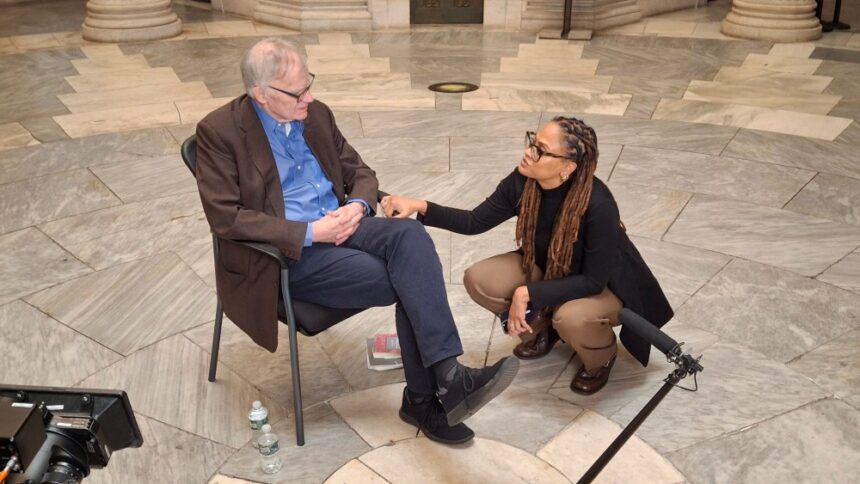
Through interviews with Rep. Alexandria Ocasio-Cortez (D-N.Y.), Rep. Anna Paulina Luna (R-Fla.), legal scholars Sherrilyn Ifill and Robert Chang, Stacey Abrams, social commentators Donald T. Critchlow and Hasan Piker and others, DuVernay explores the amendment’s history and contemporary implications.
The Netflix film is set to close the New York Film Festival and will begin streaming on Dec. 9.
This marks your return to documentary features after ‘Origin.’ What was the trigger for ‘14th’?
Spencer, at what point did you get the call from Ava?
It was never our intention to follow up ‘13th’ with this, but it led us to dig into it more and it organically became the next film.
How did the ‘Lost Cause’ become the narrative thread of ’14th’?
AVERICK: This story is about the battle over the 14th Amendment. The Civil War happened, there was a truce and there was a promise after the war. The resolution of the war was these amendments, the 14th Amendment specifically.
Immediately, there was pushback. It came in all forms: violent, legislative and cultural. The cultural war against the 14th Amendment and against Reconstruction was underneath everything — it was sneaky and hidden. It was in the form of the “Lost Cause,” which celebrated the Confederacy and the side that wanted to keep slavery alive and it continued through the 20th century.
The answer to the 14th Amendment was the “Lost Cause.” That became the beating heart of the opposition to the 14th Amendment. We might have called it the “Lost Cause” in 1876 or the early 1900s, but today, it’s called MAGA. It’s rooted in the idea that there’s a hierarchy to being an American — that some people are more capable, more deserving than others — which is the exact opposite of what the 14th Amendment stands for.
Stacey Abrams, AOC, Steve Schmidt, Dr. David Blight are among the many talking heads who feature in the doc. How did you navigate who to include?
One of the things I love about Spencer’s editing is that he might have seven people explaining the same thing, but he cuts it together in a way that feels alive. He finds the moments when people are excited.
I’m curious: Did you go out to Republicans and ask them to participate in this?
What is your call to action?
One thing that we can do is look to that moment in history and look within ourselves. Frederick Douglass was not in the government, but he pushed, prodded, spoke and taught. He got out there.
DUVERNAY: The bottom line is we can vote, and everybody should vote. But one of the things I learned through making this is you can vote, but then you’ve got to follow up on what those people do. Attend council meetings, monitor their records and know the details beyond more than what they’re saying in a campaign.
But beyond that, forget the politicians. What are you doing at the community level? Do you know your neighbor? Are you talking to people about views? Do you know someone in your life who doesn’t watch the news? How can you keep them informed?
We’re in such a mess right now that it’s going to take everyone paying attention and helping us move out of this house.
How did you know when to end the film, given the constant news cycle?
DUVERNAY: We ran out of time.
This interview has been edited and condensed for length and clarity.,