






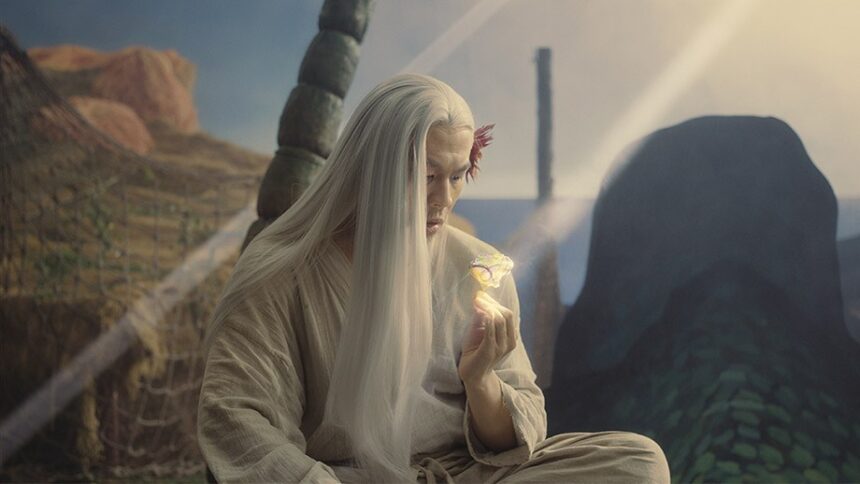
Now acting as his own production designer as well, writer-director-editor Qiu serves up more painted backdrops and practical theatrical effects, this time in an anthology film in which a cast toplined by Lee Kang-sheng play multiple roles in rhyming chapters centered around food. It’s a four-course feast for the eyes, even if “A New Old Play’s” intertwined themes of art, memory, and China’s tumultuous 20th century offered more food for thought.
“Fuxi” — a word translated by an opening title card as “a tasty delicacy, or the act of eating it” — circles ideas of ritual and community, embodied by tasty-looking Sichuan food and, at times, fairly detailed instructions for cooking it. The appeal to arthouse audiences is obvious, though the international critics and programmers who compared “A New Old Play” to Jia Zhangke’s politically ambitious “Platform” may find “Fuxi” less substantial. Qiu operates in a more folkloric mode, beginning with the film’s first segment, “The Ancestors’ Fuxi,” set among a prehistoric tribe whose members are recognizably human, except for their tails. As a member of the tribe approaches the end of her life, it is explained, she cuts off her own tail, and prepares it as a soup, to feed her descendants as part of her burial rites.
In the “Ancestors” segment, wild dogs, played by actors in masks and black unitards, howl on the village outskirts; by the second segment, they’re kept as pets, and one (voiced by Qiu himself) even narrates the story. Society has become more hierarchical: The food Lee’s character serves is an offering to her king, who has abdicated in order to live as a bird (he floats through hand-painted clouds and smoke-machine haze on digitally removed wires), but still returns once a year to taste the tribute of his subjects.
In a recurring image, Sol and Luna seesaw on a foam mountain, rising and falling in turn as the days and centuries flow by below. Qiu’s eloquence lies in such playful gestures, which are pleasurable for their own sake. “Fuxi” takes place on sets with the heightened artificiality of a Hollywood backlot; Qiu’s handcraft is so sumptuous and elaborate that “resourceful” doesn’t cover it. In an era when digital effects work — and, increasingly, gen-AI imagery — is used as a quick fix for corner-cutting productions at all budget levels, every one of “Fuxi’s” intricately wrought tactile flourishes is a luxury good.