


French President Emmanuel Macron said the Lumière Summit in Saint-Paul-de-Vence, which he co-chaired with South Korean President Lee Jae Myung on Monday, was deliberately held at a moment of dramatic upheaval for the entertainment business, from the growing dominance of YouTube and TikTok to AI and media consolidation.
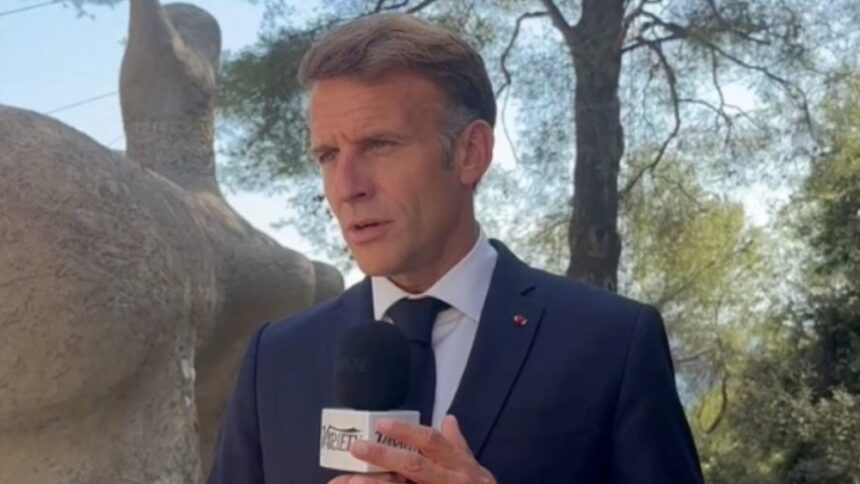
Speaking to Variety at the event, he pointed to the growing power of YouTube, TikTok and other social platforms as one of the reasons the timing was right for the landmark gathering devoted to the future of cinema and the moving image.
“YouTube is very efficient. It’s de facto the default platform in a lot of countries for a lot of people. And it’s quite clear that today they divert a lot of people from these platforms or the big channels where a lot of money is invested in creation,” said Macron at the Fondation Maeght, a French art foundation showcasing works of art from Georges Braque to Joan Miró, nestled amid a luxuriant forest.
He argued that YouTube, which is currently outtalking Netflix in over 20 international markets, should increasingly be brought into the same ecosystem as other global platforms such as Netflix, Amazon and Disney, that have been required to invest in local production.
France and other countries need to “engage with them” in a multilateral way, he said, to try to change the platform’s approach so that it helps finance “local content,” while supporting “more creativity, more creations, more respect of the authors.”
Macron, who’s been a driving force behind the rise of French AI companies, including Mistral, as well as the creation of the EU’s AI Act and the international summit on AI that was held last year, also said France wanted to compete aggressively in AI by expanding computing capacity, data centers and European models. But he insisted that technological ambition must be accompanied by protections for intellectual property and much greater transparency.
Asked about his discussions about EU regulations with companies such as Google or OpenAI, Macron said that while France is eager to compete in the AI race, it’s also pushing for greater transparency and protections for creators in Europe.
“When you have content produced by AI, you just have to know it. So transparency for us is key,” he said. “We want to flag when the content is produced with AI. Because we think it’s fair.”
Without that, Macron warned, AI could “totally transform the relationship to truth,” feeding distrust not only in creative content but in science and democracy.
The French President described the merger case as fundamentally “a U.S. M&A story,” saying his priority was ensuring that a major company like Paramount Skydance maintained a strong footprint in France and Europe. While Ellison wasn’t present at the Lumiere Summit, Paramount Skydance’s Andy Gordon was there and sat at Macron’s table at lunch, alongside The Walt Disney Company’s Dana Walden, Netflix’s Ted Sarandos, NBCUniversal Entertainment’s Donna Langley, Mediawan’s Pierre-Antoine Capton and Sony’s Tom Rothman, among others.
“What is important to us is to make sure that you will still finance creation, that you will still work with us, that you will still make more movies in France and in Europe,” he said.
Asked what would survive beyond 2027, Macron pointed first to France’s international tax credit for international movies and TV series, which was recently strengthened with the inclusion of above-the-line costs and has helped draw a growing number of major U.S. and international productions to the country.
Yet, Macron suggested the bigger battle after his departure could be over the foundations of France’s cultural policy itself.
Ultimately, Macron tied the defense of the French model not only to jobs and filmmaking but also to the country’s soft power.
“Culture and art is part of what France is, but it’s part as well of our soft power outside,” he said. “Recognizing that art is an exception which requires specific investment of the government, diversity of people, players, authors, protection of their rights and a specific effort in terms of multilateralism is crucial.”