




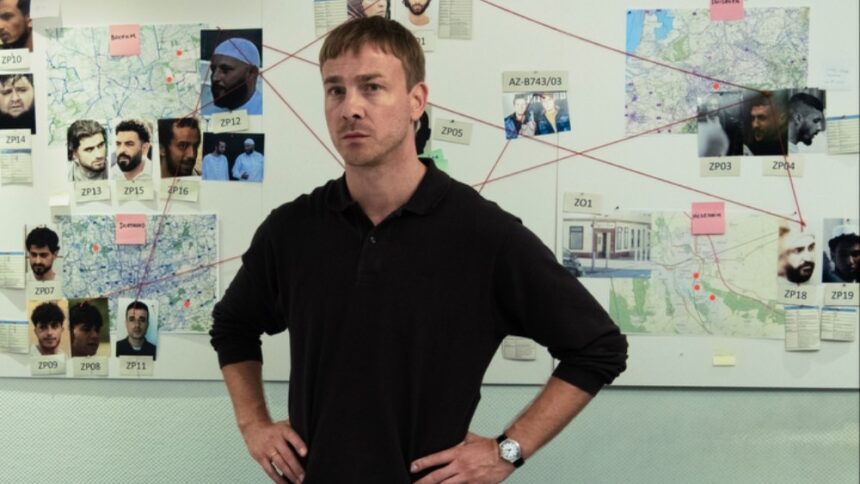
He notes: “When we were first discussed this, we said: ‘Let’s tell this story in such a gripping way that people will watch it even though they know the ending. They will hope he gets caught, even though it’s clear he won’t.”
The show, sold by Beta Film, was written by Nawrath, David Marian, Benjamin Seiler, Magdalena Grazewicz and Isabella Oliveira Parise Kröger. It’s produced by Amberger, Rafael Parente and Korbinian Dufter for Neuesuper.
“Entertainment is important in this industry, but we approached this subject with the utmost seriousness. We did our research carefully. We listened to as many perspectives as possible and looked at the issue from different angles. Of course, the big question is: ‘How do you deal with such a controversial theme?’ First, by accepting that it’s impossible to please everyone.”
Especially now. On July 25, Berlin experienced another attack when a man drove a van into a crowd of pedestrians during the Berlin Pride celebrations.
“When the information about this perpetrator came out, there were striking similarities between the two. So have we really learned our lesson?”
The team tried to stay close to the truth, but not all of the details are known to the public. Even now.
“There were major gaps that we couldn’t fill through our research. At the same time, we’re not making a documentary. We felt free to invent characters and storylines to make it more dramatic,” says Nawrath. Marian notes:
“Then there’s also the question of how to talk about the victims. We didn’t want to impose any kind of suffering on them or exploit them in any way. But we always wanted to stay as close to the facts as possible.”
Finding out more about the case was, at times, a frustrating experience. Can their show be viewed as a critique of the people who were in charge at the time?
“I hope so,” says Nawrath.
“At one point, the would-be perpetrator wanted to leave Germany. He wanted to reunite with his family. But at the border, they confiscated his belongings and his passport, and said: ‘You don’t have the right papers. You can’t go.’ He could have left the country!”
According to Amberger, the series captures “the schizophrenic face of the German bureaucracy.”
“Some rules make sense, and as a free, liberal society, we can be proud of them. On the other hand, they make us slow and keep our police at bay. We show the dilemma that the German security institutions find themselves in.”
“I’m not saying there haven’t been many obvious mistakes and a political agenda behind his ability to carry out the attack. But some of these rules help the wrong people with the wrong agendas.”
“We shouldn’t marginalize groups that feel isolated. We see that extremism arises from feelings of powerlessness. What [Marian] said is absolutely true. We are responsible for the people who feel left behind.”
In light of the recent election, which saw the triumph of Germany’s far-right party AfD, it’s easy to exploit a similar situation.
“Even to us, it’s still difficult to say what went wrong and how it could have happened. There’s no single culprit. But you could point in one direction and say: ‘No more immigration.’ That’s not be the answer.”