



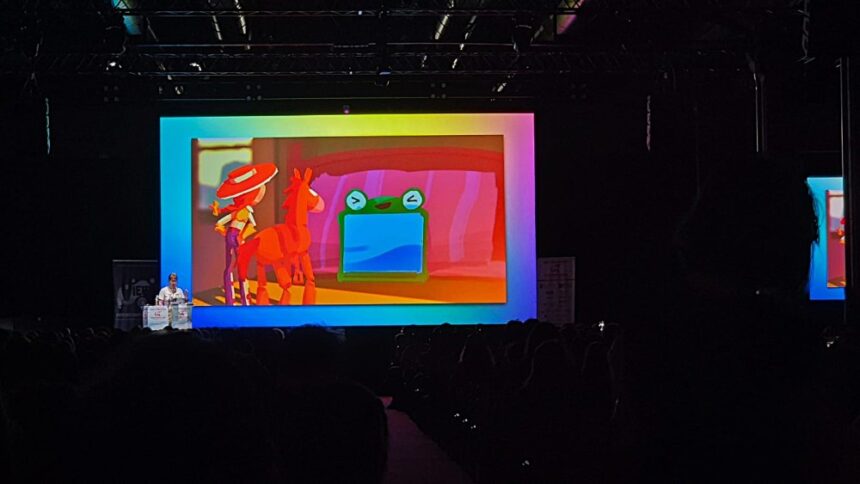
“She was my cowgirl through and through,” Harris said at View Conference in Turin on Friday, displaying childhood fan art and explaining how Jessie’s boldness became a guiding principle while making the film with director Andrew Stanton.
Stanton invited Harris to co-direct in late 2022, after work on “Luca,” “Ciao Alberto” and “Inside Out 2.” Harris accepted, then asked to co-write the screenplay despite never having tackled a feature script. “Who was I to put myself in a position this precarious, where I could very well fail in front of the man who wrote my entire childhood?” Harris recalled. The collaboration ultimately earned Harris a screenwriting credit alongside Stanton.
That willingness to take risks extended to campaigning for Jessie and Buzz to kiss amid a perilous action sequence. “I just think there should be a ton of action, and it should be perilous, and then they should kiss super duper hard,” Harris remembered telling Stanton, who agreed. Another image — Jessie riding a real horse — helped inspire the ranch setting and a new character, Blaze. Harris, production designer Bob Pauley and the story team visited BreyerFest, a Kentucky convention devoted to model horses, for research.
“We stopped production for two weeks, and focused on the film’s core issue at the time,” Harris said. “Our act one was not working.” The first week was devoted to diagnosing the problem; during the second, Harris and Stanton raced to rewrite.
Initially, Jessie’s overriding goal was simply to win back playtime with Bonnie, especially after becoming separated from her during a dance class. But early screenings showed that audiences were unmoved by a conflict that echoed the first film’s competition for a child’s attention. “The stakes of losing playtime felt too soft,” Harris explained.
The decision to put Jessie front and center was itself contested. “Part of the risk of this film was having Jessie as the protagonist,” Harris revealed, recalling questions about whether audiences would rather watch Woody and Buzz. The filmmakers held firm: those characters would remain important, but Jessie’s emotional history gave the sequel its purpose.
Harris also helped shape the movie’s imagination sequences, pushing Pixar’s artists toward more spontaneous, painterly images rather than the studio’s usual meticulous realism. “We wanted to lean into something that felt more ephemeral and fleeting,” Harris said. Rapid experiments in lighting, movement and effects became part of a process the crew called “playtime weeklies.”
The approach reflected a larger lesson in directing: learning to delegate, invite others into difficult decisions and leave space for play. Stanton’s guiding idea for the film was that “our limited time with others can impact a lifetime,” a theme that spoke both to Jessie’s journey and to Harris’ own time at Pixar.